
Why the Open Matters
The first 30 to 60 minutes of the RTHDefinitionRegular Trading Hours — 9:30 AM to 4:00 PM ET. Where 80-90% of daily futures volume happens. The main session traders focus on. session is the highest-stakes window in the trading day. This is when:
- The largest volume of the session usually transacts
- The day's directional bias often gets established
- Overnight positioning unwinds and new positions get built
- Institutional algos run their opening programs
- The Initial BalanceDefinitionThe price range of the first hour (A + B periods). Narrow IB = trend day. Wide IB = range day. forms and sets the day's framework
Get the open right and the rest of the day is easier. Get it wrong and you spend the day chasing.
The footprint is uniquely valuable at the open because it reveals immediately what kind of session you are in — without waiting for an hour of price action to develop.
The Four Open Types
There are four classic opening patterns. Each tells you something different about the session ahead.
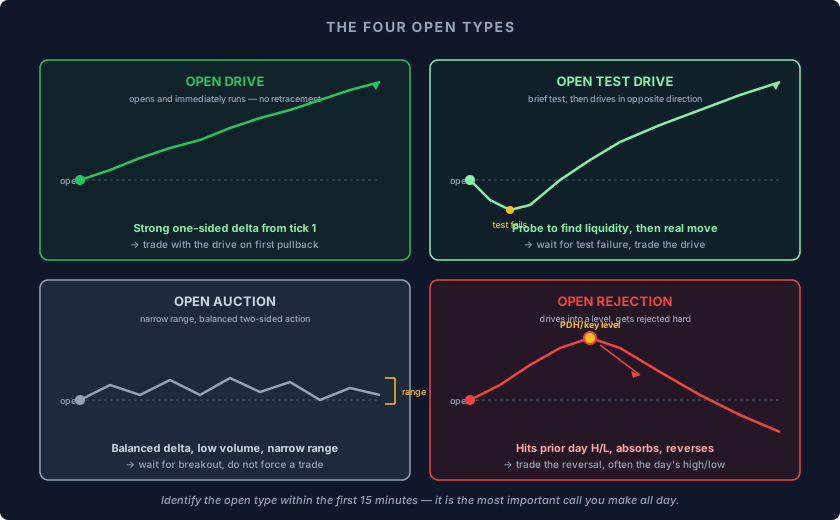
1. Open DriveDefinitionOpening pattern — price drives in one direction immediately at the bell with no retracement. Trade with the drive on first pullback.. Price opens and immediately drives in one direction with strong, persistent volume. No retracement. The market opens with a clear bias and runs.
- Footprint signature: heavy one-sided deltaDefinitionAsk volume minus bid volume. Positive = more buying. Negative = more selling. Shows who is more aggressive. from the opening tick, no two-sided action
- What it means: institutions came in with a directional plan; they are executing immediately
- Strategy: trade with the drive on the first pullback. The first 15 minutes set the day's high or low.
2. Open Test DriveDefinitionOpening pattern — brief test in one direction, then drives the other way. Wait for test failure, trade the drive.. Price opens, briefly tests in one direction (often filling overnight stops or testing prior day H/L), then drives in the opposite direction with conviction.
- Footprint signature: small initial move with weak deltaDefinitionAsk volume minus bid volume. Positive = more buying. Negative = more selling. Shows who is more aggressive., then a sharp reversal with heavy aggressive delta in the opposite direction
- What it means: the test was a probe to find liquidityDefinitionResting orders (stop losses, limit orders) at known levels. Institutions need liquidity to fill large positions.; the real move starts after the test fails
- Strategy: wait for the test to fail, then trade the drive that follows. The reversal point is the day's reference.
3. Open AuctionDefinitionOpening pattern — narrow range, balanced two-sided action. No commitment yet. Wait for breakout, do not force a trade.. Price opens and stays in a narrow range — no decisive direction. The market is in a "let's see" mode.
- Footprint signature: balanced two-sided deltaDefinitionAsk volume minus bid volume. Positive = more buying. Negative = more selling. Shows who is more aggressive., low total volume, narrow range, value bars
- What it means: no consensus yet; participants are waiting for information or for one side to commit
- Strategy: do nothing. Wait for the breakout from the opening rangeDefinitionThe high-low range of the first N minutes of RTH (commonly 5, 15, 30, or 60). The 60-minute opening range is the Initial Balance.. Trade the breakout with confirmation.
4. Open RejectionDefinitionOpening pattern — drives into a key level (PDH/PDL) and reverses hard. Often sets the day's high or low early. / Open ReversalDefinitionSynonym for Open Rejection — initial drive that gets reversed at a key level early in the session.. Price opens, immediately moves in one direction, hits a key level, and reverses hard.
- Footprint signature: initial drive with strong deltaDefinitionAsk volume minus bid volume. Positive = more buying. Negative = more selling. Shows who is more aggressive., then absorptionDefinitionHeavy aggressive orders hit a level but price doesn't move — a large passive player is absorbing the flow. / exhaustionDefinitionWhen a price extreme is reached but the aggressive volume that should be driving it is missing. Classic reversal signal — the move ran out of participants. at the level, then opposite-side aggressive delta
- What it means: the open ran into a known reference (prior day H/L, weekly POCDefinitionPoint of Control — the price with the highest volume. Where the most trading happened.) and got rejected
- Strategy: trade the reversal. Stop above (or below) the rejected extreme. Often the day's high or low is in.
The open type is the most important call you make all day. If you can identify which of these four patterns is unfolding within the first 15 minutes, you have a framework for the next 6 hours.
Reading the Initial Balance
The Initial BalanceDefinitionThe price range of the first hour (A + B periods). Narrow IB = trend day. Wide IB = range day. (IB) is the price range of the first 60 minutes of RTHDefinitionRegular Trading Hours — 9:30 AM to 4:00 PM ET. Where 80-90% of daily futures volume happens. The main session traders focus on. (in market profile terms, the A and B periods, 9:30–10:30 ET on US futures).
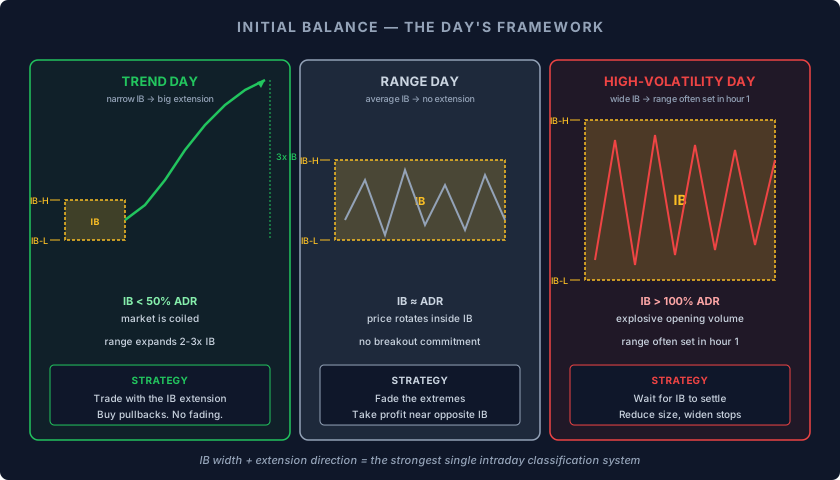
The IB tells you the day's range potential:
- Narrow IB (under 50% of recent average daily range) → trend dayDefinitionA session where price moves persistently in one direction. Typically signaled by narrow IB + strong extension. Trade with the trend. potential. The market is coiled.
- Average IB (around recent ADR) → normal range dayDefinitionA session where price oscillates within a range. Typically signaled by average IB + no extension. Fade extremes.. Trade rotations within IB extremes.
- Wide IB (over 100% of recent ADR) → high-volatility day. The day's range may be set within the first hour.
Then watch for IB extensionDefinitionWhen price breaks above IB high or below IB low. Direction of extension is a strong intraday bias signal. 1x IB extension = trend day potential.:
- IB extends up → bullish bias for the rest of the session
- IB extends down → bearish bias for the rest of the session
- No IB extensionDefinitionWhen price breaks above IB high or below IB low. Direction of extension is a strong intraday bias signal. 1x IB extension = trend day potential. → balance/rotation day
The combination of IB width + extension direction is the strongest single intraday classification system.
Footprint Tells in the First 30 Minutes
What to watch for in the opening footprint:
1. Opening deltaDefinitionAsk volume minus bid volume. Positive = more buying. Negative = more selling. Shows who is more aggressive. direction. The first 5 minutes of cumulative deltaDefinitionRunning total of buying vs selling across the session. Shows who has been in control overall. tells you who showed up to trade. Strong positive delta in the first 5 minutes = institutional buying programs. Strong negative = institutional selling.
2. Footprint at the opening price. Is there absorptionDefinitionHeavy aggressive orders hit a level but price doesn't move — a large passive player is absorbing the flow. at the open price (large passive participation)? Or is it pure aggression (one side hitting the other immediately)? Absorption at the open often defines the day's pivot.
3. Reaction at overnight references. Prior day high, prior day low, overnight high, overnight low — each gets tested at or near the open. Watch the footprint at each test for absorptionDefinitionHeavy aggressive orders hit a level but price doesn't move — a large passive player is absorbing the flow., exhaustionDefinitionWhen a price extreme is reached but the aggressive volume that should be driving it is missing. Classic reversal signal — the move ran out of participants., or breakout.
4. The first failed test. When price tests an overnight extreme and fails (fails to break, or breaks and reverses), that failure is your first major directional clue.
5. POCDefinitionPoint of Control — the price with the highest volume. Where the most trading happened. migration in the first 30 minutes. If the developing POC migrates higher each bar, buyers are in control. If it migrates lower, sellers are. Stable POC = balance.
Common Opening Setups
The Opening RangeDefinitionThe high-low range of the first N minutes of RTH (commonly 5, 15, 30, or 60). The 60-minute opening range is the Initial Balance. Breakout (ORBDefinitionOpening Range Breakout — entry on the first sustained breakout above OR-high or below OR-low. Confirmed by aggressive footprint in the breakout direction.). Wait 30–60 minutes for the IB to form. Trade the first sustained breakout above IB high or below IB low, confirmed by aggressive footprint in the breakout direction.
The Opening Drive Pullback. On Open DriveDefinitionOpening pattern — price drives in one direction immediately at the bell with no retracement. Trade with the drive on first pullback. days, the first 5–10 minutes establish strong directional deltaDefinitionAsk volume minus bid volume. Positive = more buying. Negative = more selling. Shows who is more aggressive.. Wait for the first pullback (usually within 20 minutes) and enter with the drive. Stop on the opposite side of the pullback.
The Failed Open Test. On Open Test DriveDefinitionOpening pattern — brief test in one direction, then drives the other way. Wait for test failure, trade the drive. days, the initial probe sets a reference (the test high or test low). When price reverses through the open price, enter with the reversal. Target the opposite end of the IB.
The Opening Rejection at PDHDefinitionPrior Day High — the highest price from yesterday's RTH session. A key level every trader watches./PDLDefinitionPrior Day Low — the lowest price from yesterday's RTH session. A key level every trader watches.. Price opens and immediately drives toward prior day high (or low). Watch for absorptionDefinitionHeavy aggressive orders hit a level but price doesn't move — a large passive player is absorbing the flow. + exhaustionDefinitionWhen a price extreme is reached but the aggressive volume that should be driving it is missing. Classic reversal signal — the move ran out of participants. at the level. Short the rejection with stop above PDH. Often the day's high is in within the first 30 minutes.
What to Avoid
- Trading the first 5 minutes without context — the open is chaotic. The first 5 minutes often have wild swings before settling. Wait for at least 5–10 minutes of price action before committing.
- Forcing a trade on Open AuctionDefinitionOpening pattern — narrow range, balanced two-sided action. No commitment yet. Wait for breakout, do not force a trade. days — when the open is balanced, the right move is to wait. Trying to force a trade in chop loses money.
- Chasing the Open DriveDefinitionOpening pattern — price drives in one direction immediately at the bell with no retracement. Trade with the drive on first pullback. late — by the time you "see" the drive, the best entry is gone. Either get in early on the first pullback or skip and wait for the next session.
- Ignoring overnight context — the open does not happen in a vacuum. Where did overnight close relative to RTHDefinitionRegular Trading Hours — 9:30 AM to 4:00 PM ET. Where 80-90% of daily futures volume happens. The main session traders focus on. value? What's the gap size? What overnight references are in play? Always have this map before the bell rings.
The Bottom Line
The first hour writes the script for the rest of the day. The footprint at the open tells you which of the four open types is unfolding, where the Initial BalanceDefinitionThe price range of the first hour (A + B periods). Narrow IB = trend day. Wide IB = range day. will form, and which overnight references matter most. Read the open well and the rest of the session becomes a series of high-probability follow-throughs.
Build a 5-minute pre-bell checklist: prior day H/L, overnight H/L, naked POCsDefinitionPrior-session POCs that price never retested. Act as magnets — price tends to come back to them., key VWAPs. When the bell rings, identify the open type within 15 minutes. Let the IB form. Then trade the framework the open created.