
Why Multiple Timeframes?
A single timeframe gives you one view of the market. Multiple timeframes give you context, bias, and timing — three different jobs that one chart cannot do well.
The professional approach: structure on the higher timeframeDefinitionThe longest timeframe in a multi-timeframe stack — typically daily or 4-hour. Determines overall bias., signals on the middle timeframe, execution on the lower timeframeDefinitionThe shortest timeframe in a multi-timeframe stack — typically 1m or range bars. Used for trade triggers.. Each timeframe answers a specific question.
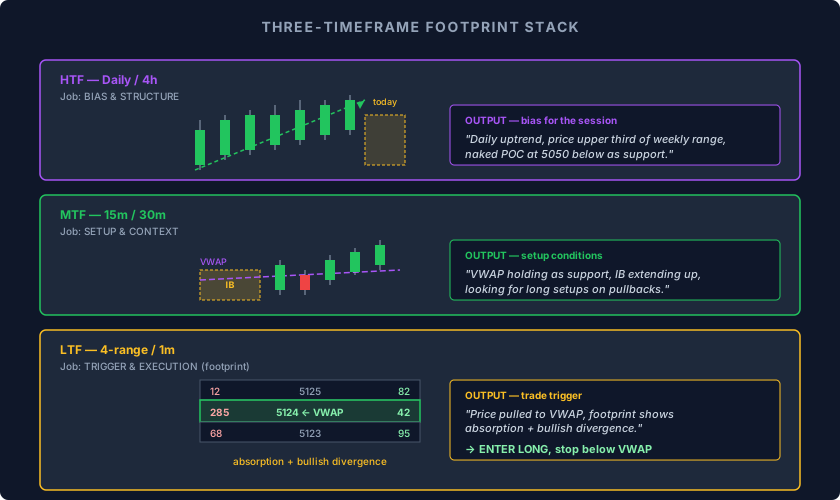
This is sometimes called the "top-down" approach. It is one of the most consistent profitability boosters that experienced traders adopt.
The Three-Timeframe Stack
A typical setup uses three timeframes spaced roughly 4–6x apart:
| Timeframe | Job | What You Watch | |---|---|---| | Higher (HTF) — daily / 4-hour / 1-hour | Bias and structure | Trend direction, key levels (PDHDefinitionPrior Day High — the highest price from yesterday's RTH session. A key level every trader watches./PDLDefinitionPrior Day Low — the lowest price from yesterday's RTH session. A key level every trader watches., weekly POCDefinitionPoint of Control — the price with the highest volume. Where the most trading happened., naked POCsDefinitionPrior-session POCs that price never retested. Act as magnets — price tends to come back to them.), market profile shape | | Middle (MTF) — 15m / 30m | Setup and context | Initial BalanceDefinitionThe price range of the first hour (A + B periods). Narrow IB = trend day. Wide IB = range day., VWAPDefinitionVolume Weighted Average Price — the average price weighted by volume. Institutional benchmark for fair value., intraday structure, where price is in the day's range | | Lower (LTF) — 4-range / 8-range / 1m | Trigger and execution | Footprint signatures, absorptionDefinitionHeavy aggressive orders hit a level but price doesn't move — a large passive player is absorbing the flow., exhaustionDefinitionWhen a price extreme is reached but the aggressive volume that should be driving it is missing. Classic reversal signal — the move ran out of participants., deltaDefinitionAsk volume minus bid volume. Positive = more buying. Negative = more selling. Shows who is more aggressive. divergence, entry timing |
The HTF tells you which way to lean. The MTF tells you when conditions are right. The LTF tells you exactly when to pull the trigger.
The Top-Down Workflow
Each session, walk down the timeframes:
Step 1 — Higher timeframeDefinitionThe longest timeframe in a multi-timeframe stack — typically daily or 4-hour. Determines overall bias. (5 minutes before the session)
- What's the daily/weekly trend? Bullish, bearish, balanced?
- Where is price in the higher-timeframe range?
- What naked POCsDefinitionPrior-session POCs that price never retested. Act as magnets — price tends to come back to them. are nearby?
- What's the higher-timeframe value relative to the current price?
Output: a one-line bias. *"Daily uptrend, price in the upper third of weekly range, naked POCDefinitionPrior-session POCs that price never retested. Act as magnets — price tends to come back to them. at 5050 below as support, no major reference until 5180 above."*
Step 2 — Middle timeframe (during the session, every 15-30 minutes)
- Where is the Initial BalanceDefinitionThe price range of the first hour (A + B periods). Narrow IB = trend day. Wide IB = range day.?
- Where is VWAPDefinitionVolume Weighted Average Price — the average price weighted by volume. Institutional benchmark for fair value. relative to price?
- What does the developing market profile look like?
- Where are intraday key levels (session high, session low, prior session POCDefinitionPoint of Control — the price with the highest volume. Where the most trading happened.)?
Output: setup conditions. *"VWAPDefinitionVolume Weighted Average Price — the average price weighted by volume. Institutional benchmark for fair value. holding as support, price building value above PDHDefinitionPrior Day High — the highest price from yesterday's RTH session. A key level every trader watches., IB extensionDefinitionWhen price breaks above IB high or below IB low. Direction of extension is a strong intraday bias signal. 1x IB extension = trend day potential. up, looking for long setups on pullbacks."*
Step 3 — Lower timeframeDefinitionThe shortest timeframe in a multi-timeframe stack — typically 1m or range bars. Used for trade triggers. (continuously)
- When price reaches a setup level, what is the footprint doing?
- AbsorptionDefinitionHeavy aggressive orders hit a level but price doesn't move — a large passive player is absorbing the flow.? ExhaustionDefinitionWhen a price extreme is reached but the aggressive volume that should be driving it is missing. Classic reversal signal — the move ran out of participants.? Stacked imbalancesDefinition3+ consecutive price levels where one side overwhelms the other by 3:1. Marks institutional zones.? Delta divergenceDefinitionWhen price and cumulative delta disagree at swing extremes. Order flow weakening before price confirms — early-warning signal.?
- Is the LTF signal aligned with HTF bias?
Output: trade trigger. *"Price pulled back to VWAPDefinitionVolume Weighted Average Price — the average price weighted by volume. Institutional benchmark for fair value., footprint shows absorptionDefinitionHeavy aggressive orders hit a level but price doesn't move — a large passive player is absorbing the flow. + bullish divergenceDefinitionPrice prints a lower low while delta prints a higher low. Sellers losing fuel — buy signal at the new low., entering long with stop below VWAP."*
Why Alignment Matters
The single most important MTF principle: only take trades where the lower timeframeDefinitionThe shortest timeframe in a multi-timeframe stack — typically 1m or range bars. Used for trade triggers. signal aligns with the higher timeframeDefinitionThe longest timeframe in a multi-timeframe stack — typically daily or 4-hour. Determines overall bias. bias.
If the daily is bullish, take only longs on the lower timeframeDefinitionThe shortest timeframe in a multi-timeframe stack — typically 1m or range bars. Used for trade triggers.. Skip the shorts even if they look perfect intraday.
If the daily is bearish, take only shorts. Skip the longs.
If the daily is balanced, you can take both directions but with reduced size.
Counter-trend trades against the higher timeframeDefinitionThe longest timeframe in a multi-timeframe stack — typically daily or 4-hour. Determines overall bias. have a much lower win rate. Most traders lose money on these even when their LTF signal is "great." The market keeps grinding back in the HTF direction.
Trade Direction Filter (Simple Version)
A clean three-rule filter:
- HTF in clear trend? → Take only trades in the direction of the trend.
- HTF in balance? → Take both directions but trade the extremes only (fade VAHDefinitionValue Area High — the upper boundary of the zone where 70% of volume traded. Acts as resistance./VALDefinitionValue Area Low — the lower boundary of the zone where 70% of volume traded. Acts as support. of the higher timeframeDefinitionThe longest timeframe in a multi-timeframe stack — typically daily or 4-hour. Determines overall bias.).
- HTF unclear? → Stand aside or trade smaller. Mixed timeframe signals are the most expensive trades to take.
Common MTF Setups
The HTF-Aligned Pullback. Daily uptrend. Intraday pullback to VWAPDefinitionVolume Weighted Average Price — the average price weighted by volume. Institutional benchmark for fair value. or POCDefinitionPoint of Control — the price with the highest volume. Where the most trading happened.. LTF footprint shows absorptionDefinitionHeavy aggressive orders hit a level but price doesn't move — a large passive player is absorbing the flow. + bullish divergenceDefinitionPrice prints a lower low while delta prints a higher low. Sellers losing fuel — buy signal at the new low. at the pullback low. Long with the trend.
The HTF Reversal at a Major Level. Daily uptrend stretching into a major weekly resistance. MTF profile showing exhaustionDefinitionWhen a price extreme is reached but the aggressive volume that should be driving it is missing. Classic reversal signal — the move ran out of participants. at the high. LTF showing climax volumeDefinitionAbnormally high volume (2-5x average) on a single bar that ends a trend with sharp reversal. + bearish divergenceDefinitionPrice prints a higher high while delta prints a lower high. Buyers losing fuel — sell signal at the new high.. Counter-trend short — but smaller size, tighter stop, because you're fighting the daily.
The HTF Range Fade. Daily in balance, price stretching to one extreme of the multi-day range. MTF showing test of the prior range edge. LTF showing absorptionDefinitionHeavy aggressive orders hit a level but price doesn't move — a large passive player is absorbing the flow. + reversal signature. Fade back toward the middle of the range.
The HTF Breakout Continuation. Daily breaking out of a range with conviction. MTF showing strong directional flow. LTF pullbacks getting bought. Long every pullback to the LTF MA or VWAPDefinitionVolume Weighted Average Price — the average price weighted by volume. Institutional benchmark for fair value., take partials at MTF resistance.
Common Mistakes
- Skipping the HTF check — entering off pure LTF signals without context is the #1 reason newer traders lose. The LTF chart "looks" perfect 50% of the time even when the HTF says no.
- Too many timeframes — three is the sweet spot. Adding a fourth or fifth creates analysis paralysis.
- Wrong timeframe ratios — keep your timeframes spaced 4–6x apart. Daily / 15m / 1m is too far. 1h / 15m / 4-range is good.
- Forgetting to refresh the HTF view — re-check the higher timeframeDefinitionThe longest timeframe in a multi-timeframe stack — typically daily or 4-hour. Determines overall bias. at least once during the session. If conditions changed (new news, broken structure), the bias changes.
The Two-Chart vs Three-Chart Setup
Some traders use only two charts:
- Two-chart: HTF context (15m or 30m) + LTF execution (range barsDefinitionBars that close after price moves a fixed amount. Uniform bar size produces cleaner footprint signatures. Best for execution.). Simpler.
- Three-chart: Daily/4h bias + 15m setup + range execution. Fuller picture.
The two-chart works fine if you check the daily/weekly view briefly before each session. The three-chart is more thorough but requires more screen real estate and attention.
Time Required Per Session
A disciplined MTF workflow takes about:
- 5 minutes pre-session — review HTF bias, mark key levels
- 2 minutes per setup — confirm MTF context and LTF signal alignment
- Continuous monitoring — LTF chart for trigger, MTF chart for context
That is much less time than most traders spend chart-hopping randomly. The structure makes you faster and more accurate.
The Bottom Line
One timeframe shows you a piece of the market. Three timeframes show you the whole market — bias, setup, trigger. The discipline of always confirming alignment across timeframes is one of the highest-ROI habits in discretionary trading.
Higher timeframeDefinitionThe longest timeframe in a multi-timeframe stack — typically daily or 4-hour. Determines overall bias. for direction. Middle timeframe for context. Lower timeframeDefinitionThe shortest timeframe in a multi-timeframe stack — typically 1m or range bars. Used for trade triggers. for execution. Take only trades where all three align.