
What Is Delta Divergence?
Delta divergenceDefinitionWhen price and cumulative delta disagree at swing extremes. Order flow weakening before price confirms — early-warning signal. is when price and order flow disagree. Price makes a new high — but the buying pressure that should be driving it is weakening. Or price makes a new low — but the selling pressure has dried up.
Price tells you what happened. Delta tells you who did it. When the two stop agreeing, the move is on borrowed time.
This is one of the most powerful reversal signals in order flow because it shows you the move is failing *before* the chart shows the reversal. By the time price confirms with a candlestick pattern, the divergence reader is already positioned.
Bullish Divergence (Price Lower Low, Delta Higher Low)
Price makes a new low — but cumulative deltaDefinitionRunning total of buying vs selling across the session. Shows who has been in control overall. makes a *higher* low. Sellers pushed price down further but committed less aggression than the previous low. The drop is losing fuel.
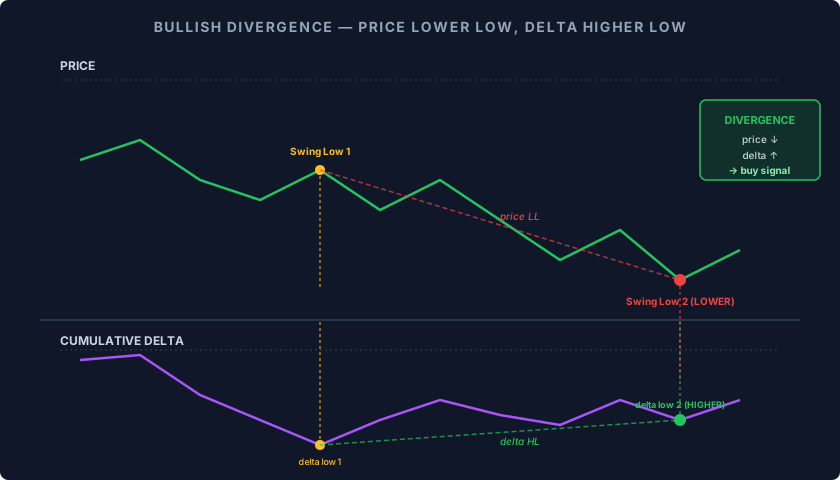
What it means: the sellers who were aggressive at the previous low are not as committed at the new low. The flush is running out of participants. Buyers will likely take over.
What to look for:
- A clear prior swing lowDefinitionA trough on the chart where price reversed higher. Marks where buyers previously overpowered sellers. with strong negative deltaDefinitionAsk volume minus bid volume. Positive = more buying. Negative = more selling. Shows who is more aggressive.
- A new lower low in price
- Cumulative deltaDefinitionRunning total of buying vs selling across the session. Shows who has been in control overall. that is higher (less negative) at the new low
- Bonus confirmation: bullish absorptionDefinitionHeavy aggressive orders hit a level but price doesn't move — a large passive player is absorbing the flow. signature on the new low
This is the signature of a failed flushDefinitionA move down to a new low with weak delta — sellers couldn't muster the aggression they had before. Bottom signal. — sellers tried to extend the move but couldn't muster the aggression they had before.
Bearish Divergence (Price Higher High, Delta Lower High)
The mirror image. Price makes a new high — but cumulative deltaDefinitionRunning total of buying vs selling across the session. Shows who has been in control overall. makes a *lower* high. Buyers pushed price up further but committed less aggression than at the previous high. The rally is losing fuel.
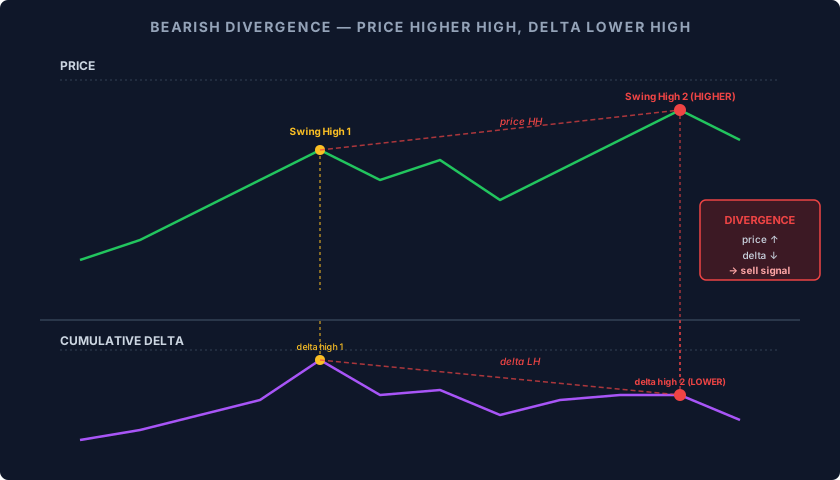
What it means: the buyers who were aggressive at the previous high are not as committed at the new high. The push up is running out of participants. Sellers will likely take over.
This is the signature of a failed breakout — buyers tried to extend the move but couldn't muster the aggression they had before. Often paired with exhaustionDefinitionWhen a price extreme is reached but the aggressive volume that should be driving it is missing. Classic reversal signal — the move ran out of participants. at the new high.
Hidden divergenceDefinitionContinuation signal — opposite of regular divergence. Often more reliable for trend-following entries. is the inverse — and it signals trend *continuation*, not reversal.
- Hidden bullish: price makes a higher low (uptrend pullback) but deltaDefinitionAsk volume minus bid volume. Positive = more buying. Negative = more selling. Shows who is more aggressive. makes a lower low. Sellers tried hard but only got a shallow price retracement. The trend is strong; buyers are absorbing the selling. Long the next push.
- Hidden bearish: price makes a lower high (downtrend bounce) but deltaDefinitionAsk volume minus bid volume. Positive = more buying. Negative = more selling. Shows who is more aggressive. makes a higher high. Buyers tried hard but only got a shallow bounce. The downtrend is strong. Short the next push.
Hidden divergenceDefinitionContinuation signal — opposite of regular divergence. Often more reliable for trend-following entries. is less famous than regular divergence but more reliable for trend-following entries.
Why Divergence Works
Markets move because of order flow, not because of price. Price is a *result*; order flow is the *cause*. When the cause weakens but the result keeps going, the result has to eventually catch up.
Imagine a car coasting up a hill with the engine off. The car is still moving up — but it's losing speed every second. Eventually it will roll back. Delta divergenceDefinitionWhen price and cumulative delta disagree at swing extremes. Order flow weakening before price confirms — early-warning signal. is the moment you notice the engine sound has stopped, even though the car is still rolling forward.
Where to Watch for Divergence
Divergence is everywhere — most of it is noise. The high-edge spots:
- At known structural levels — PDHDefinitionPrior Day High — the highest price from yesterday's RTH session. A key level every trader watches., PDLDefinitionPrior Day Low — the lowest price from yesterday's RTH session. A key level every trader watches., weekly highs/lows, naked POCsDefinitionPrior-session POCs that price never retested. Act as magnets — price tends to come back to them., VWAPDefinitionVolume Weighted Average Price — the average price weighted by volume. Institutional benchmark for fair value.
- At session extremes — the high or low of the day
- During the second test of a level — divergence between the first test and second test is meaningful
- After an extended move — the longer the trend, the more meaningful the divergence
Divergence in mid-range, mid-session, with no level nearby = noise. Skip it.
Common Mistakes
- Trading divergence too early — divergence shows weakness, not the reversal itself. Wait for price confirmation (failed continuation, structural break, absorptionDefinitionHeavy aggressive orders hit a level but price doesn't move — a large passive player is absorbing the flow. at the new extreme) before entering.
- Ignoring time-frame mismatch — divergence on a 1-minute chart inside a 15-minute trend is noise. Match your divergence timeframe to your trade timeframe.
- Counting every minor deltaDefinitionAsk volume minus bid volume. Positive = more buying. Negative = more selling. Shows who is more aggressive. wiggle — meaningful divergence has a clear prior swing for reference. Eyeballing tiny variations is overfitting.
- Forgetting the stop — divergence-based reversals fail. Always have a stop above (or below) the divergent extreme.
The Setup: Trading Divergence Properly
A clean bearish divergenceDefinitionPrice prints a higher high while delta prints a lower high. Buyers losing fuel — sell signal at the new high. trade:
- Identify a key resistance level (prior day high, naked POCDefinitionPrior-session POCs that price never retested. Act as magnets — price tends to come back to them. overhead)
- Wait for price to make a higher high INTO that level
- Check cumulative deltaDefinitionRunning total of buying vs selling across the session. Shows who has been in control overall. — does it confirm with a higher high, or diverge with a lower high?
- If it diverges, look for a confirmation: exhaustionDefinitionWhen a price extreme is reached but the aggressive volume that should be driving it is missing. Classic reversal signal — the move ran out of participants. at the new high, or failed continuation on the next bar
- Short on the failed continuation. Stop above the divergent high. Target the next reference below.
The same setup inverted gives you the bullish divergenceDefinitionPrice prints a lower low while delta prints a higher low. Sellers losing fuel — buy signal at the new low. trade.
The Bottom Line
Divergence is the order-flow trader's early-warning system. Price can lie — it can drift to a new extreme on weak participation. Delta cannot lie. When price says one thing and deltaDefinitionAsk volume minus bid volume. Positive = more buying. Negative = more selling. Shows who is more aggressive. says another, trust delta. Always.
Use divergence to *anticipate* reversals at key levels. Use price action to *confirm* them. That sequence keeps you out of premature entries while still putting you ahead of the herd.