
Prior Day High and Prior Day Low
Of all the key levels traders watch, the most popular are these two:
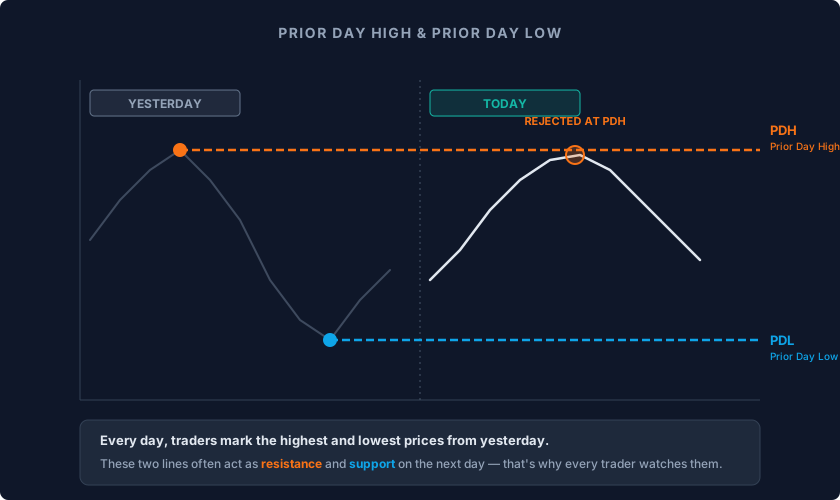
- Prior Day HighDefinitionThe highest price reached during yesterday's RTH session. Often acts as resistance when price approaches today. (PDHDefinitionPrior Day High — the highest price from yesterday's RTH session. A key level every trader watches.) — the highest price the market reached yesterday
- Prior Day LowDefinitionThe lowest price reached during yesterday's RTH session. Often acts as support when price approaches today. (PDLDefinitionPrior Day Low — the lowest price from yesterday's RTH session. A key level every trader watches.) — the lowest price the market reached yesterday
They are simple to find, simple to mark, and they show up on almost every professional trader's chart. Understanding them is the first real "level trading" skill.
What They Are (Exactly)
- PDHDefinitionPrior Day High — the highest price from yesterday's RTH session. A key level every trader watches. = the highest price during yesterday's RTHDefinitionRegular Trading Hours — 9:30 AM to 4:00 PM ET. Where 80-90% of daily futures volume happens. The main session traders focus on. session (9:30 AM – 4:00 PM ET)
- PDLDefinitionPrior Day Low — the lowest price from yesterday's RTH session. A key level every trader watches. = the lowest price during yesterday's RTHDefinitionRegular Trading Hours — 9:30 AM to 4:00 PM ET. Where 80-90% of daily futures volume happens. The main session traders focus on. session (9:30 AM – 4:00 PM ET)
Some traders use the 24-hour high and low instead, which includes overnight. Both are valid. RTHDefinitionRegular Trading Hours — 9:30 AM to 4:00 PM ET. Where 80-90% of daily futures volume happens. The main session traders focus on.-only is cleaner because it filters out low-volume spikes.
Once you have those two prices, you draw horizontal lines at each one. Those lines extend forward into today — and often tomorrow, and sometimes for several more days.
Why These Levels Matter
Remember from the last lesson: levels matter because people remember. PDHDefinitionPrior Day High — the highest price from yesterday's RTH session. A key level every trader watches. and PDLDefinitionPrior Day Low — the lowest price from yesterday's RTH session. A key level every trader watches. are extreme cases of this — because they were the furthest price traveled in either direction all day yesterday.
At those two prices:
- Buyers gave up at the high
- Sellers gave up at the low
- Many traders took profits, got stopped out, or flipped positions
- Orders and algorithms are stacked around them waiting for the next test
When today's price approaches PDHDefinitionPrior Day High — the highest price from yesterday's RTH session. A key level every trader watches. or PDLDefinitionPrior Day Low — the lowest price from yesterday's RTH session. A key level every trader watches., it is walking into a decision zone. Either it holds (the level acts as resistance or support, and price turns back), or it breaks (the level flips and price extends in that direction).
The Three Things That Can Happen
When today's price reaches PDHDefinitionPrior Day High — the highest price from yesterday's RTH session. A key level every trader watches. or PDLDefinitionPrior Day Low — the lowest price from yesterday's RTH session. A key level every trader watches., one of three things happens:
1. Rejection
Price approaches the level, tags it, and turns back. Buyers defended PDLDefinitionPrior Day Low — the lowest price from yesterday's RTH session. A key level every trader watches.. Sellers defended PDHDefinitionPrior Day High — the highest price from yesterday's RTH session. A key level every trader watches.. The level held.
Traders watching for rejection setups often take the opposite direction — short near PDHDefinitionPrior Day High — the highest price from yesterday's RTH session. A key level every trader watches., long near PDLDefinitionPrior Day Low — the lowest price from yesterday's RTH session. A key level every trader watches..
2. Clean Break
Price pushes through the level and keeps going. The level flipped its role. PDHDefinitionPrior Day High — the highest price from yesterday's RTH session. A key level every trader watches. that breaks upward may act as support on a pullback. PDLDefinitionPrior Day Low — the lowest price from yesterday's RTH session. A key level every trader watches. that breaks downward may act as resistance on a bounce.
Traders watching for breakout setups go in the direction of the break — long above PDHDefinitionPrior Day High — the highest price from yesterday's RTH session. A key level every trader watches., short below PDLDefinitionPrior Day Low — the lowest price from yesterday's RTH session. A key level every trader watches..
3. The Fake
Price pokes above PDHDefinitionPrior Day High — the highest price from yesterday's RTH session. A key level every trader watches. (or below PDLDefinitionPrior Day Low — the lowest price from yesterday's RTH session. A key level every trader watches.), hangs for a moment, then reverses and closes back inside the prior day's range. This is a false break — the worst-case outcome for breakout traders and a great reversal signal for reversal traders.
False breaks are common at these levels. That is why experienced traders wait for confirmation — usually a close beyond the level, not just a wick — before assuming the break is real.
Simple Rules for Using PDH and PDL
- Mark them on every chart, every day — it takes 10 seconds. Either draw horizontal lines manually or use an indicator that does it automatically
- Pay extra attention when price approaches them — slow down, note the time, watch volume
- Do not assume the level will hold or break — let the market show you
- Watch for reactions, not just touches — a clean push with big volume is different from a weak drift to the level
If you only watched two lines on your chart, PDHDefinitionPrior Day High — the highest price from yesterday's RTH session. A key level every trader watches. and PDLDefinitionPrior Day Low — the lowest price from yesterday's RTH session. A key level every trader watches. would be the two. Almost every day, the market has a story to tell at these prices.
Common Mistakes
- Not marking them — if they are not on your chart, they are not helping you
- Trading every touch — levels are decision zones, not guaranteed bounces
- Ignoring the context — PDHDefinitionPrior Day High — the highest price from yesterday's RTH session. A key level every trader watches. above a big multi-day downtrend hits different than PDH inside a rally. Know where you sit
- Forgetting they age — PDHDefinitionPrior Day High — the highest price from yesterday's RTH session. A key level every trader watches. from yesterday matters more than PDH from three days ago. The fresher the level, the more active