
Why Bar Type Matters for Footprints
The footprint shows you the volume distributionDefinitionPhase 3 of Power of 3. The real move — Smart Money distributes into retail momentum. inside each bar. The shape and meaning of those distributions depends entirely on how you're carving up the market — by time (every 1m, 5m, 15m) or by price movement (every 4 ticks, 8 ticks, etc.).
Most retail traders use time barsDefinitionBars that close after a fixed time interval. The default for most charting. Best for context, not order-flow execution. by default because that's what they grew up with. But experienced footprint readers often switch to range barsDefinitionBars that close after price moves a fixed amount. Uniform bar size produces cleaner footprint signatures. Best for execution. or tick barsDefinitionBars that close after a fixed number of trades. Adapts to activity rather than time or price. for a fundamentally different — and often clearer — view of order flow.
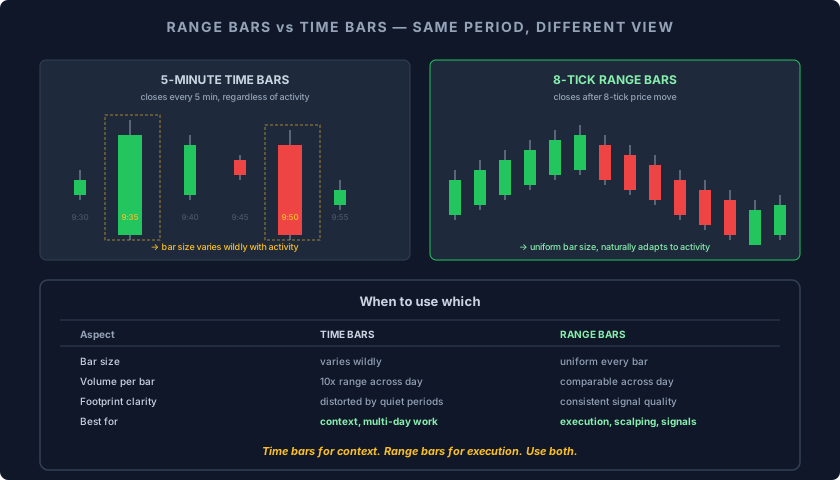
Choosing the right bar type for your strategy is one of the single biggest leverage points in your setup.
Time Bars
Time barsDefinitionBars that close after a fixed time interval. The default for most charting. Best for context, not order-flow execution. close every N minutes. A 5-minute chart prints a new bar every 5 minutes regardless of how much price moved or how many trades happened.
Pros: - Easy to think about — every trader uses time - Fixed bar boundaries align with session events (open, close, news releases) - Easy to compare bars across sessions - Volume profile per bar is meaningful (5 minutes of activity)
Cons: - Volume varies wildly — a 5m bar at 9:30 ET has 10x the volume of a 5m bar at 11:30 ET - Quiet periods produce tiny, meaningless bars; busy periods produce huge bars that miss intra-bar detail - Footprint signatures get distorted by volume variability — exhaustionDefinitionWhen a price extreme is reached but the aggressive volume that should be driving it is missing. Classic reversal signal — the move ran out of participants. in a low-volume barDefinitionBars that close after a fixed quantity of contracts traded. Rarely used by discretionary traders. looks the same as in a high-volume bar but means much less - News spikes mid-bar get hidden inside the time bucket
Best for: session-context analysis, multi-day comparisons, market profile work, lower-frequency trading.
Range barsDefinitionBars that close after price moves a fixed amount. Uniform bar size produces cleaner footprint signatures. Best for execution. close when price moves a fixed amount — typically 4, 8, or 16 ticks. A 4-range bar closes every time price has traveled 4 ticks (in either direction).
Pros: - Uniform bar size — every bar represents the same price movement - Volume per bar reflects intensity, not just clock time - Quiet periods produce few bars; busy periods produce many — naturally adapts to volatility - Cleaner footprint signatures because each bar has comparable price range - Better for spotting absorptionDefinitionHeavy aggressive orders hit a level but price doesn't move — a large passive player is absorbing the flow., exhaustionDefinitionWhen a price extreme is reached but the aggressive volume that should be driving it is missing. Classic reversal signal — the move ran out of participants., and stacked imbalancesDefinition3+ consecutive price levels where one side overwhelms the other by 3:1. Marks institutional zones. since they're not muddled by quiet periods
Cons: - Bars don't align to clock time — harder to mark "what happened at 10:30" - Session events (open, close) don't fall on bar boundaries - Daily/weekly volume profiles don't aggregate cleanly - Some platforms calculate range barsDefinitionBars that close after price moves a fixed amount. Uniform bar size produces cleaner footprint signatures. Best for execution. differently (which causes confusion)
Best for: scalping, intraday execution, footprint signal trading, high-frequency reading of order flow.
Tick Bars
Tick barsDefinitionBars that close after a fixed number of trades. Adapts to activity rather than time or price. close after a fixed number of trades (e.g., 1000 ticks per bar). A new bar prints every time 1000 trades execute, regardless of price movement.
Pros: - Volume per bar is exactly fixed (well, within 1 tick of fixed) - Adapts to activity rather than time or range - Useful when activity matters more than price movement (e.g., during news)
Cons: - Even harder to align with time-based events - Volume varies because individual trades vary in size (a 1-lot tick = a 100-lot tick = 1 tick) - Less common in futures than range barsDefinitionBars that close after price moves a fixed amount. Uniform bar size produces cleaner footprint signatures. Best for execution.
Best for: specialized scalping strategies, news event trading, volume-event analysis.
Volume Bars
Volume barsDefinitionBars that close after a fixed quantity of contracts traded. Rarely used by discretionary traders. close after a fixed amount of contracts have traded (e.g., 5000 contracts). The fairest representation of "activity" but rarely used because volume varies even within a session.
Best for: academic research, advanced quant work — most discretionary traders skip these.
Choosing the Right Bar Type for Your Strategy
| Your Strategy | Recommended Bar Type | |---|---| | Multi-day swing trading | 30m or 1h time barsDefinitionBars that close after a fixed time interval. The default for most charting. Best for context, not order-flow execution. | | Intraday context (Initial BalanceDefinitionThe price range of the first hour (A + B periods). Narrow IB = trend day. Wide IB = range day., VWAPDefinitionVolume Weighted Average Price — the average price weighted by volume. Institutional benchmark for fair value.) | 5m or 15m time bars | | Reading order flow signals (absorptionDefinitionHeavy aggressive orders hit a level but price doesn't move — a large passive player is absorbing the flow., exhaustionDefinitionWhen a price extreme is reached but the aggressive volume that should be driving it is missing. Classic reversal signal — the move ran out of participants.) | 4-range or 8-range barsDefinitionBars that close after price moves a fixed amount. Uniform bar size produces cleaner footprint signatures. Best for execution. | | Scalping the open | 1m time bars or 4-range bars | | News event execution | Tick barsDefinitionBars that close after a fixed number of trades. Adapts to activity rather than time or price. or 4-range bars | | Footprint absorption setups | Range bars (every signal is bigger and clearer) |
The general rule: time barsDefinitionBars that close after a fixed time interval. The default for most charting. Best for context, not order-flow execution. for context, range barsDefinitionBars that close after price moves a fixed amount. Uniform bar size produces cleaner footprint signatures. Best for execution. for execution.
A Two-Chart Workflow
Most professional footprint traders run two charts side by side:
- Context chart — 15m or 30m time barsDefinitionBars that close after a fixed time interval. The default for most charting. Best for context, not order-flow execution. with market profile, VWAPDefinitionVolume Weighted Average Price — the average price weighted by volume. Institutional benchmark for fair value., prior day levels. Used for the bias and key levels.
- Execution chart — 4-range or 8-range barsDefinitionBars that close after price moves a fixed amount. Uniform bar size produces cleaner footprint signatures. Best for execution. with footprint, stacked imbalancesDefinition3+ consecutive price levels where one side overwhelms the other by 3:1. Marks institutional zones., deltaDefinitionAsk volume minus bid volume. Positive = more buying. Negative = more selling. Shows who is more aggressive.. Used for entry timing.
The context chart says "bullish bias, watch the 5125 level for absorptionDefinitionHeavy aggressive orders hit a level but price doesn't move — a large passive player is absorbing the flow.." The execution chart says "absorption signature just printed at 5125, enter long with stop at 5122."
This division of labor is much more powerful than trying to do everything on a single chart.
Common Mistakes
- Using one chart for everything — time barsDefinitionBars that close after a fixed time interval. The default for most charting. Best for context, not order-flow execution. don't show order flow detail; range barsDefinitionBars that close after price moves a fixed amount. Uniform bar size produces cleaner footprint signatures. Best for execution. don't show context. You need both.
- Wrong range size — too small (1-range) and every bar is noise; too large (32-range) and you lose the signal granularity. Start with 4-range for indices, 8-range for less liquid instruments.
- Confusing range barsDefinitionBars that close after price moves a fixed amount. Uniform bar size produces cleaner footprint signatures. Best for execution. with renkoDefinitionBrick-style chart with fixed up/down boxes that ignore wicks. Distinct from range bars. — renko bars have fixed up/down boxes that ignore wicks; range bars preserve the actual high/low. Footprint trading uses range bars, not renko.
- Switching bar types mid-trade — pick your setup before the session, stick to it.
How Many Bars to Display
Range barsDefinitionBars that close after price moves a fixed amount. Uniform bar size produces cleaner footprint signatures. Best for execution. at high resolution generate a LOT of bars. A 4-range chart on ESDefinitionE-mini S&P 500 futures contract. Tracks the S&P 500 index. 1 tick = $12.50, 1 point = $50. Most heavily traded index future. during RTHDefinitionRegular Trading Hours — 9:30 AM to 4:00 PM ET. Where 80-90% of daily futures volume happens. The main session traders focus on. can produce 200+ bars in a single session. That's actually fine — order flow traders read intensity, not count.
For execution charts:
- 4-range or 8-range: load 100–200 bars (about 1–3 hours of action)
- Tick barsDefinitionBars that close after a fixed number of trades. Adapts to activity rather than time or price.: load 50–100 bars
- Time barsDefinitionBars that close after a fixed time interval. The default for most charting. Best for context, not order-flow execution. (5m): load 100–200 bars (about 8–16 hours)
Loading less is usually better — it forces you to focus on what's happening NOW rather than scrolling through history.
The Bottom Line
Time barsDefinitionBars that close after a fixed time interval. The default for most charting. Best for context, not order-flow execution. are clocks. Range barsDefinitionBars that close after price moves a fixed amount. Uniform bar size produces cleaner footprint signatures. Best for execution. are activity meters. For footprint trading, activity is what matters — not time. Switch to range bars for execution and you'll see absorptionDefinitionHeavy aggressive orders hit a level but price doesn't move — a large passive player is absorbing the flow., exhaustionDefinitionWhen a price extreme is reached but the aggressive volume that should be driving it is missing. Classic reversal signal — the move ran out of participants., and stacked imbalancesDefinition3+ consecutive price levels where one side overwhelms the other by 3:1. Marks institutional zones. much more clearly than you ever did on time bars.
Use time barsDefinitionBars that close after a fixed time interval. The default for most charting. Best for context, not order-flow execution. for context (session structure, profile, VWAPDefinitionVolume Weighted Average Price — the average price weighted by volume. Institutional benchmark for fair value.). Use range barsDefinitionBars that close after price moves a fixed amount. Uniform bar size produces cleaner footprint signatures. Best for execution. for execution (entries, stops, footprint signatures). The two-chart workflow is the professional standard for a reason.