
The POCDefinitionPoint of Control — the price with the highest volume. Where the most trading happened. is the price level with the highest total volume over a given period. It is the single most important level on the volume profile because it represents fair value — the price where the market did the most business.
Think of it as the market's center of gravity. Price tends to return to the POCDefinitionPoint of Control — the price with the highest volume. Where the most trading happened. because it is where the most participants agreed on value. When price moves away from the POC, it is either discovering new value or overextending.
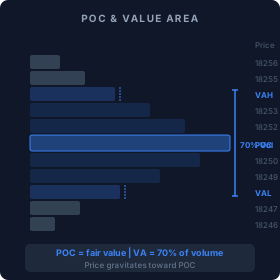
The POCDefinitionPoint of Control — the price with the highest volume. Where the most trading happened. is not a support or resistance line — it is a magnet. Price does not bounce off the POC like a wall. It gravitates toward it because that is where the most trading interest exists.
Value Area High (VAH) and Value Area Low (VAL)
The Value AreaDefinitionThe price range where 70% of volume traded. Defined by Value Area High (VAH) and Value Area Low (VAL). is the range of prices where approximately 70% of total volume traded during a session. The top of this range is the Value Area HighDefinitionThe top of the Value Area — the highest price in the zone where 70% of volume traded.. The bottom is the Value Area LowDefinitionThe bottom of the Value Area — the lowest price in the zone where 70% of volume traded..
Why the Value AreaDefinitionThe price range where 70% of volume traded. Defined by Value Area High (VAH) and Value Area Low (VAL). matters:
- It tells you where the market accepted price — if 70% of volume traded between 18248 and 18254, the market agreed that was fair value
- Anything above the VAHDefinitionValue Area High — the upper boundary of the zone where 70% of volume traded. Acts as resistance. was considered expensive, anything below the VALDefinitionValue Area Low — the lower boundary of the zone where 70% of volume traded. Acts as support. was considered cheap
- The prior session's Value AreaDefinitionThe price range where 70% of volume traded. Defined by Value Area High (VAH) and Value Area Low (VAL). becomes the reference for the next session
How to trade using the Value AreaDefinitionThe price range where 70% of volume traded. Defined by Value Area High (VAH) and Value Area Low (VAL).:
- Opens inside the prior Value AreaDefinitionThe price range where 70% of volume traded. Defined by Value Area High (VAH) and Value Area Low (VAL). — expect rotation and balance, the market is accepting the same range
- Opens above the VAHDefinitionValue Area High — the upper boundary of the zone where 70% of volume traded. Acts as resistance. — buyers pushed beyond what was considered expensive. Either a breakout or a rejection back into value
- Opens below the VALDefinitionValue Area Low — the lower boundary of the zone where 70% of volume traded. Acts as support. — sellers pushed beyond what was considered cheap. Either a breakdown or a bounce back into value
Price outside the Value AreaDefinitionThe price range where 70% of volume traded. Defined by Value Area High (VAH) and Value Area Low (VAL). is at an extreme. It will either continue in the direction of the breakout or get rejected back into value. The VAHDefinitionValue Area High — the upper boundary of the zone where 70% of volume traded. Acts as resistance. and VALDefinitionValue Area Low — the lower boundary of the zone where 70% of volume traded. Acts as support. are your decision points.
Higher Timeframe Sessions: Where the Real Levels Are
The POCDefinitionPoint of Control — the price with the highest volume. Where the most trading happened. and Value AreaDefinitionThe price range where 70% of volume traded. Defined by Value Area High (VAH) and Value Area Low (VAL). from a single 15-minute candle are interesting. The POC and Value Area from the prior day, the prior week, or the prior month are where the real money trades.
Higher timeframeDefinitionThe longest timeframe in a multi-timeframe stack — typically daily or 4-hour. Determines overall bias. sessions and what to watch:
- Daily POCDefinitionPoint of Control — the price with the highest volume. Where the most trading happened. — one of the most watched levels in futures trading. Above yesterday's POC = bullish. Below = bearish. Institutional traders use it as their benchmark for fair value
- Daily VAHDefinitionValue Area High — the upper boundary of the zone where 70% of volume traded. Acts as resistance. and VALDefinitionValue Area Low — the lower boundary of the zone where 70% of volume traded. Acts as support. — the first major support and resistance levels of the new session. Watch how price reacts within the first 30 minutes. Rejection at VAH = sellers defending. Acceptance above = market repricing higher
- Weekly POCDefinitionPoint of Control — the price with the highest volume. Where the most trading happened. — carries even more weight because it represents five days of accumulated institutional activity. The consensus fair value for the week
- Weekly VAHDefinitionValue Area High — the upper boundary of the zone where 70% of volume traded. Acts as resistance. and VALDefinitionValue Area Low — the lower boundary of the zone where 70% of volume traded. Acts as support. — if price is trading inside the prior week's Value AreaDefinitionThe price range where 70% of volume traded. Defined by Value Area High (VAH) and Value Area Low (VAL)., the market has not changed its mind. If it breaks out, a directional move is likely
- Composite ProfilesDefinitionMultiple sessions combined into one profile. Composite POCs and Value Areas carry more weight than single sessions. — combine multiple sessions into one profile. A POCDefinitionPoint of Control — the price with the highest volume. Where the most trading happened. that has held across three weeks is far more significant than a single day's POC. When price approaches a composite POCDefinitionPOC of a multi-session composite profile. Carries more weight than any single-session POC., expect a reaction
The higher the timeframe of the Value AreaDefinitionThe price range where 70% of volume traded. Defined by Value Area High (VAH) and Value Area Low (VAL)., the more significant the level. A daily VAHDefinitionValue Area High — the upper boundary of the zone where 70% of volume traded. Acts as resistance. might hold for a few hours. A weekly VAH might hold for days. A monthly POCDefinitionPoint of Control — the price with the highest volume. Where the most trading happened. is a level the entire market watches.
VWAP: The Institutional Benchmark
VWAPDefinitionVolume Weighted Average Price — the average price weighted by volume. Institutional benchmark for fair value. stands for Volume Weighted Average Price. It is the average price of the session weighted by volume — meaning prices where more contracts traded pull the average toward them more than prices where few contracts traded.
VWAPDefinitionVolume Weighted Average Price — the average price weighted by volume. Institutional benchmark for fair value. is the single most important intraday level for institutional traders. When a fund needs to buy 10,000 contracts during the session, their benchmark is VWAP. If they buy at prices below VWAP, they outperformed. If they buy above VWAP, they underperformed. This is why VWAP acts as a magnet and a decision point throughout the day.
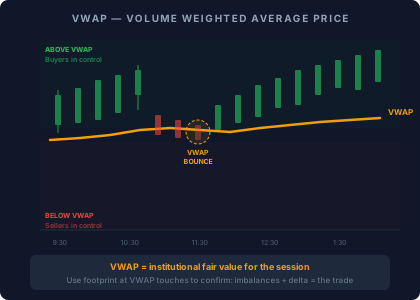
VWAPDefinitionVolume Weighted Average Price — the average price weighted by volume. Institutional benchmark for fair value. on its own is just a line on a chart. What makes it powerful is combining it with the footprint. When price pulls back to VWAP, the question is: will it hold or break? The footprint answers that in real-time:
- Watch for buying imbalancesDefinitionA price level where one side overwhelms the other by 3:1 or more. Shows where big players committed. at VWAPDefinitionVolume Weighted Average Price — the average price weighted by volume. Institutional benchmark for fair value. — 3:1 or greater ratios mean institutional participants are defending fair value
- Watch deltaDefinitionAsk volume minus bid volume. Positive = more buying. Negative = more selling. Shows who is more aggressive. — if it flips positive as price touches VWAPDefinitionVolume Weighted Average Price — the average price weighted by volume. Institutional benchmark for fair value., buyers are stepping in
- Watch absorptionDefinitionHeavy aggressive orders hit a level but price doesn't move — a large passive player is absorbing the flow. — if heavy selling hits VWAPDefinitionVolume Weighted Average Price — the average price weighted by volume. Institutional benchmark for fair value. but price does not break below, a large passive buyer is absorbing the flow
VWAPDefinitionVolume Weighted Average Price — the average price weighted by volume. Institutional benchmark for fair value. is where you look. The footprint tells you what is happening when price gets there. A VWAP bounce with stacked buying imbalancesDefinitionA price level where one side overwhelms the other by 3:1 or more. Shows where big players committed. and positive deltaDefinitionAsk volume minus bid volume. Positive = more buying. Negative = more selling. Shows who is more aggressive. is one of the highest-probability long entries in intraday futures trading.
VWAPDefinitionVolume Weighted Average Price — the average price weighted by volume. Institutional benchmark for fair value. as dynamic support and resistance:
- Bullish session — VWAPDefinitionVolume Weighted Average Price — the average price weighted by volume. Institutional benchmark for fair value. acts as support. Every pullback to VWAP is a potential buying opportunity. Price above VWAP means buyers are willing to pay more than the session average
- Bearish session — VWAPDefinitionVolume Weighted Average Price — the average price weighted by volume. Institutional benchmark for fair value. acts as resistance. Every rally to VWAP is a potential selling opportunity. Price below VWAP means sellers are in control
- VWAPDefinitionVolume Weighted Average Price — the average price weighted by volume. Institutional benchmark for fair value. cross — a significant shift in control. Below to above = buyers took over. Above to below = sellers took over
Confluence — when VWAPDefinitionVolume Weighted Average Price — the average price weighted by volume. Institutional benchmark for fair value., POCDefinitionPoint of Control — the price with the highest volume. Where the most trading happened., and Value AreaDefinitionThe price range where 70% of volume traded. Defined by Value Area High (VAH) and Value Area Low (VAL). align:
- VWAPDefinitionVolume Weighted Average Price — the average price weighted by volume. Institutional benchmark for fair value. and prior session POCDefinitionPoint of Control — the price with the highest volume. Where the most trading happened. at the same price = double significance. Both the session average and prior fair value agree
- VWAPDefinitionVolume Weighted Average Price — the average price weighted by volume. Institutional benchmark for fair value. at the VAHDefinitionValue Area High — the upper boundary of the zone where 70% of volume traded. Acts as resistance. or VALDefinitionValue Area Low — the lower boundary of the zone where 70% of volume traded. Acts as support. = confluence of the session average and the boundary of accepted value
- These multi-level confluences produce the highest-conviction trades of the session
When VWAPDefinitionVolume Weighted Average Price — the average price weighted by volume. Institutional benchmark for fair value., POCDefinitionPoint of Control — the price with the highest volume. Where the most trading happened., and the Value AreaDefinitionThe price range where 70% of volume traded. Defined by Value Area High (VAH) and Value Area Low (VAL). all point to the same level — that is where institutions are making their decisions. Combine that with footprint confirmation and you have the highest-conviction trade of the session.
POC Migration: Confirming or Warning
Watch how the POCDefinitionPoint of Control — the price with the highest volume. Where the most trading happened. shifts from one session to the next. If the daily POC is moving higher each day, the market is accepting higher prices — the trend is healthy. If the POC is flat while price makes new highs, the volume is not following price. The move lacks conviction and is likely to fail.
POCDefinitionPoint of Control — the price with the highest volume. Where the most trading happened. migration is a simple but powerful confirmation tool. Rising POC = real trend. Flat POC with rising price = warning. The volume has to agree with the price movement or the move is not sustainable.