
What Is a Naked POC?
A naked POCDefinitionPrior-session POCs that price never retested. Act as magnets — price tends to come back to them. (also called a virgin POCDefinitionSynonym for naked POC — an untested prior-session Point of Control. Acts as a magnet for price. or untested POCDefinitionA POC from a prior period that price has not returned to. Daily, weekly, and composite untested POCs all act as magnets.) is a Point of ControlDefinitionThe price level with the highest volume. Represents fair value — where the market attracted the most interest. from a prior session that price has never returned to test. It sits there on the chart, undefended — and the market tends to come back and tap it.
Recall: the POCDefinitionPoint of Control — the price with the highest volume. Where the most trading happened. is the price where the most volume traded during a session. It represents fair value — where the heaviest two-sided business happened. When a session ends and price never trades back at that POC, it leaves an "unfinished" reference behind.
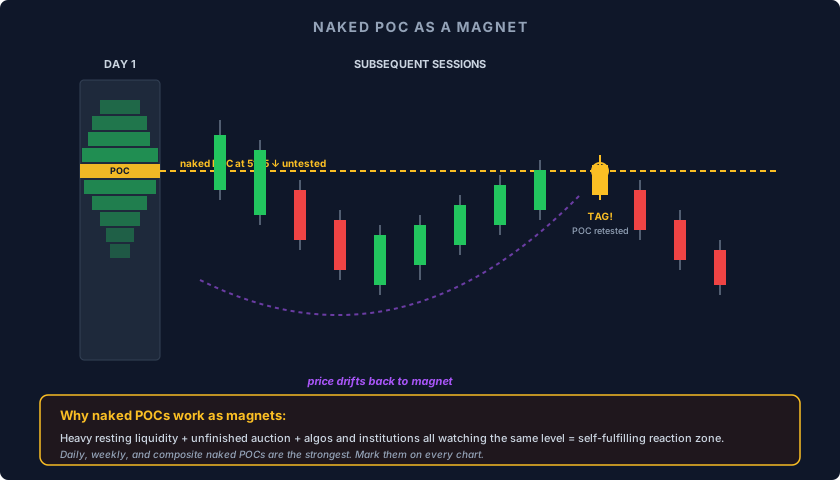
Markets have a strong tendency to revisit naked POCsDefinitionPrior-session POCs that price never retested. Act as magnets — price tends to come back to them.. Some traders build entire strategies around this single concept.
Why Untested POCs Are Magnets
Three reasons:
1. LiquidityDefinitionResting orders (stop losses, limit orders) at known levels. Institutions need liquidity to fill large positions. is concentrated there. The POCDefinitionPoint of Control — the price with the highest volume. Where the most trading happened. by definition is where the most contracts traded. There are still resting limit orders, working positions, and open interest tied to that price. Liquidity attracts price.
2. The auction is unfinished. In auction market theoryDefinitionMarkets alternate between balance (rotation) and imbalance (trending). Determines your strategy., when price moves away from a high-volume nodeDefinitionA local high-volume area on the volume profile. Acts as support/resistance; price pauses and reacts at HVNs. without retesting it, the market has not completed its job of accepting or rejecting that fair value. The market wants to test it again.
3. Algorithmic and institutional reference. Naked POCsDefinitionPrior-session POCs that price never retested. Act as magnets — price tends to come back to them. are tracked by every serious trading desk. When price approaches one, both algos and discretionary traders react. Self-fulfilling prophecy at the institutional level.
Untested POCsDefinitionA POC from a prior period that price has not returned to. Daily, weekly, and composite untested POCs all act as magnets. from earlier sessions act as magnets. Markets revisit them more often than chance would predict. This is one of the most reliable structural patterns in futures trading.
Types of Naked POCs
Different timeframes produce different magnets:
- Daily naked POCDefinitionPrior-session POCs that price never retested. Act as magnets — price tends to come back to them. — POC from a prior day's RTHDefinitionRegular Trading Hours — 9:30 AM to 4:00 PM ET. Where 80-90% of daily futures volume happens. The main session traders focus on. session that never got retested in subsequent sessions. Most common reference; usually tested within 1–5 days.
- Overnight naked POCDefinitionPrior-session POCs that price never retested. Act as magnets — price tends to come back to them. — POC from the prior Globex/ETHDefinitionExtended Trading Hours — overnight and premarket sessions outside RTH. Market is open but volume is thin and moves can be erratic. session that never traded during RTHDefinitionRegular Trading Hours — 9:30 AM to 4:00 PM ET. Where 80-90% of daily futures volume happens. The main session traders focus on.. Often tested early in the next RTH session.
- Weekly naked POCDefinitionPrior-session POCs that price never retested. Act as magnets — price tends to come back to them. — POC from a prior week. Less frequent but high-conviction; often tested within the next 2–4 weeks.
- Composite naked POCDefinitionPrior-session POCs that price never retested. Act as magnets — price tends to come back to them. — POC from a multi-day composite profileDefinitionMultiple sessions combined into one profile. Composite POCs and Value Areas carry more weight than single sessions.. Tracks the major structural levels across a balance area.
- Monthly naked POCDefinitionPrior-session POCs that price never retested. Act as magnets — price tends to come back to them. — POC from a full month. Multi-month magnets; the longest-term references.
The longer the timeframe and the longer it has been untested, the stronger the magnet.
How to Find Them
You don't need to hunt for these manually. Most volume profile tools (including FI OrderFlow's market profile mode) automatically identify and label naked POCsDefinitionPrior-session POCs that price never retested. Act as magnets — price tends to come back to them.:
- Look for POCDefinitionPoint of Control — the price with the highest volume. Where the most trading happened. lines that extend forward in time without being tested
- Filter by timeframe — daily, weekly, monthly
- Pay attention to which side of current price they sit on (above = upside magnet, below = downside magnet)
Mark them on your chart. Treat them as targets, not guarantees.
Trading Naked POCs
Two main playbooks:
1. Naked POCDefinitionPrior-session POCs that price never retested. Act as magnets — price tends to come back to them. as a target. If price is trending and there's a naked POC in the path of the move, you can use it as a take-profit target. Trends often pause or reverse at naked POCs.
2. Naked POCDefinitionPrior-session POCs that price never retested. Act as magnets — price tends to come back to them. as an entry. When price reaches a naked POC, watch the footprint for a reaction:
- Acceptance + reversal — price tests the POCDefinitionPoint of Control — the price with the highest volume. Where the most trading happened., finds responsive participation, and reverses back in the original direction. Trade the reversal.
- Acceptance + continuation — price tests the POCDefinitionPoint of Control — the price with the highest volume. Where the most trading happened., accepts it as new value, and continues through. The naked POCDefinitionPrior-session POCs that price never retested. Act as magnets — price tends to come back to them. has been "filled" and is no longer a reference.
- Rejection — price approaches the POCDefinitionPoint of Control — the price with the highest volume. Where the most trading happened. but stops short and reverses without touching. The magnet pulled but didn't catch. The POC is still naked.
The richest setups happen when a naked POCDefinitionPrior-session POCs that price never retested. Act as magnets — price tends to come back to them. aligns with another reference — VWAPDefinitionVolume Weighted Average Price — the average price weighted by volume. Institutional benchmark for fair value., prior day high/low, a major swing point. Confluence multiplies edge.
Magnets vs Reactions
Important distinction: a naked POCDefinitionPrior-session POCs that price never retested. Act as magnets — price tends to come back to them. is a magnet (price wants to come) — but the *reaction* at the POC is a separate trade. Don't confuse the two.
- Magnet trade: "I'll fade this current move because the naked POCDefinitionPrior-session POCs that price never retested. Act as magnets — price tends to come back to them. overhead is pulling price up." → Long for a target at the POC.
- Reaction trade: "Price has reached the naked POCDefinitionPrior-session POCs that price never retested. Act as magnets — price tends to come back to them.. Now I'll watch the footprint to see if buyers defend or if sellers respond." → Trade based on what shows up at the level.
Combining both: take a partial profit when price reaches the naked POCDefinitionPrior-session POCs that price never retested. Act as magnets — price tends to come back to them., hold a runner based on what the reaction looks like.
When Naked POCs Fail
Naked POCsDefinitionPrior-session POCs that price never retested. Act as magnets — price tends to come back to them. work most of the time — not always. Common failure modes:
- Major news event — Fed announcements, NFP, geopolitical shocks invalidate prior structure. Naked POCsDefinitionPrior-session POCs that price never retested. Act as magnets — price tends to come back to them. from before the event lose meaning.
- Multi-week trend — in a strong trend, distant naked POCsDefinitionPrior-session POCs that price never retested. Act as magnets — price tends to come back to them. against the trend may never be tested. The trend takes price further before it pauses.
- Stale references — naked POCsDefinitionPrior-session POCs that price never retested. Act as magnets — price tends to come back to them. from months ago in a market that has moved hundreds of points are too far away to act as magnets.
Use recency and proximity as filters. Recent (within 1–10 sessions), nearby (within reasonable ATR), and aligned with current structure are the best.
The Bottom Line
Naked POCsDefinitionPrior-session POCs that price never retested. Act as magnets — price tends to come back to them. are the market's unfinished business. The auction left them untested, and the market wants to come back and finish the job. This is one of the most reliable structural tendencies in futures trading.
Mark them on every chart. Use them as targets when trading with the trend and as reaction zones when trading against. When a naked POCDefinitionPrior-session POCs that price never retested. Act as magnets — price tends to come back to them. aligns with another reference, the edge multiplies.