
What Is a Trapped-Trader Setup?
A trapped-trader setup happens when price breaks a key level, retail momentum traders pile in expecting continuation, and then price reverses back through the level — leaving those traders holding losing positions. The forced unwind of those losers fuels the reversal.
This is one of the most reliable intraday patterns in futures because it exploits a structural weakness of retail trading: chasing breakouts.
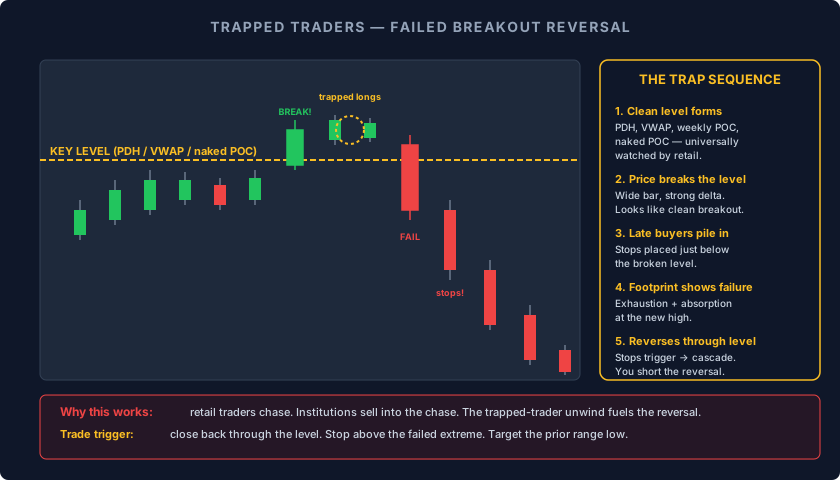
The footprint reveals trapped tradersDefinitionRetail traders who chase a breakout just before it fails. The forced unwind of their stops fuels the reversal — one of the most reliable intraday patterns. in real time — you can see exactly when the late buyers (or sellers) committed and when their positions started losing.
The Anatomy of a Trapped Trader
Five-step sequence:
- A clean horizontal level forms — prior day high/low, session VWAPDefinitionVolume Weighted Average Price — the average price weighted by volume. Institutional benchmark for fair value., weekly high, naked POCDefinitionPrior-session POCs that price never retested. Act as magnets — price tends to come back to them., IB extreme. The market consolidates against it.
- Price breaks the level — usually with strong deltaDefinitionAsk volume minus bid volume. Positive = more buying. Negative = more selling. Shows who is more aggressive. and a wide-range barDefinitionBars that close after price moves a fixed amount. Uniform bar size produces cleaner footprint signatures. Best for execution.. Looks like a clean breakout.
- Late traders pile in — momentum chasers buy the breakout (or short the breakdown), placing stops just inside the prior range
- Price stalls within 1–3 bars — exhaustionDefinitionWhen a price extreme is reached but the aggressive volume that should be driving it is missing. Classic reversal signal — the move ran out of participants. or absorptionDefinitionHeavy aggressive orders hit a level but price doesn't move — a large passive player is absorbing the flow. signature appears at the breakout extreme
- Price reverses back through the level — triggering the stops of the trapped tradersDefinitionRetail traders who chase a breakout just before it fails. The forced unwind of their stops fuels the reversal — one of the most reliable intraday patterns.
Once those stops trigger, the reversal accelerates. The footprint shows aggressive flow in the new direction as the trapped positions get force-closed.
Why It Works
Markets reward the patient and punish the impatient. Breakout chasers pay top tick (or bottom tick) and have no plan if it fails. They place stops just inside the level they bought above, which makes their stops PREDICTABLE — institutional traders know where they are.
When institutions want to short a level (or long one), the most efficient way to fill their order is to:
- Let price break the level so retail piles in
- Sell into the late buyers (taking the other side of their trades)
- Push price back through the level to trigger their stops
- Buy back at much better prices (covering against forced sellers)
The trapped-trader unwind is the fuel for the reversal. This is mechanical, not theoretical.
How to Spot It on the Footprint
Watch the breakout bar:
Healthy breakout (continuation):
- Strong one-sided deltaDefinitionAsk volume minus bid volume. Positive = more buying. Negative = more selling. Shows who is more aggressive. into and through the level
- Heavy aggressive volume on the breakout side at every price
- Subsequent bars hold above the broken level with continued participation
Failed breakout (trapped tradersDefinitionRetail traders who chase a breakout just before it fails. The forced unwind of their stops fuels the reversal — one of the most reliable intraday patterns.):
- Initial strong deltaDefinitionAsk volume minus bid volume. Positive = more buying. Negative = more selling. Shows who is more aggressive. into the level, then *weaker* delta past the level
- ExhaustionDefinitionWhen a price extreme is reached but the aggressive volume that should be driving it is missing. Classic reversal signal — the move ran out of participants. signature at the new extreme — vacuum at the top of the breakout bar
- AbsorptionDefinitionHeavy aggressive orders hit a level but price doesn't move — a large passive player is absorbing the flow. appearing on the breakout side as institutions take the other side
- Bearish divergenceDefinitionPrice prints a higher high while delta prints a lower high. Buyers losing fuel — sell signal at the new high. on cumulative deltaDefinitionRunning total of buying vs selling across the session. Shows who has been in control overall. vs the prior swing highDefinitionA peak on the chart where price reversed lower. Marks where sellers previously overpowered buyers.
- Subsequent bars fail to follow through; price drifts back toward the level
The combination of exhaustionDefinitionWhen a price extreme is reached but the aggressive volume that should be driving it is missing. Classic reversal signal — the move ran out of participants. at the new extreme + absorptionDefinitionHeavy aggressive orders hit a level but price doesn't move — a large passive player is absorbing the flow. + deltaDefinitionAsk volume minus bid volume. Positive = more buying. Negative = more selling. Shows who is more aggressive. divergence is the signature.
The Setup
Conditions to wait for:
- Identify a key level beforehand (PDHDefinitionPrior Day High — the highest price from yesterday's RTH session. A key level every trader watches., PDLDefinitionPrior Day Low — the lowest price from yesterday's RTH session. A key level every trader watches., weekly POCDefinitionPoint of Control — the price with the highest volume. Where the most trading happened., naked POCDefinitionPrior-session POCs that price never retested. Act as magnets — price tends to come back to them., IB extensionDefinitionWhen price breaks above IB high or below IB low. Direction of extension is a strong intraday bias signal. 1x IB extension = trend day potential.)
- Wait for price to break the level
- Watch the footprint at the new extreme — exhaustionDefinitionWhen a price extreme is reached but the aggressive volume that should be driving it is missing. Classic reversal signal — the move ran out of participants. or absorptionDefinitionHeavy aggressive orders hit a level but price doesn't move — a large passive player is absorbing the flow.?
- Wait for price to fail to follow through (typically within 2–4 bars)
- Enter on the close back through the level
- Stop just beyond the failed extreme
- Target: the opposite side of the prior range, then extend with the reversal
Bonus confirmation: if you can see DOMDefinitionDepth of Market — the live order book. Shows passive intent (resting limit orders) at every price level around the inside market. activity, watch for institutional bidDefinitionThe highest price someone is currently willing to pay to buy. If you sell at market, this is what you get. (or offer) walls appearing AS price breaks the level. Those are the institutions taking the other side of the breakout.
Where Trapped-Trader Setups Are Most Reliable
The setup works best at:
- Prior day high/low — universally watched levels
- Weekly highs/lows — even more watched
- Session VWAPDefinitionVolume Weighted Average Price — the average price weighted by volume. Institutional benchmark for fair value. — institutional benchmark with maximum chase potential
- Naked POCsDefinitionPrior-session POCs that price never retested. Act as magnets — price tends to come back to them. from prior sessions — magnet plus retail breakout target
- Round numbers (5000 on ESDefinitionE-mini S&P 500 futures contract. Tracks the S&P 500 index. 1 tick = $12.50, 1 point = $50. Most heavily traded index future., 20000 on NQDefinitionE-mini Nasdaq 100 futures contract. Known for fast, volatile moves. 1 tick = $5, 1 point = $20.) — psychological levels
- Earnings or news event highs/lows — extra retail attention
The more participants watching the level, the more retail traders will chase the break, and the more fuel for the reversal.
Common Mistakes
- Trading every breakout failure — not all failed breakouts are trapped-trader setups. Confirm with footprint signature (exhaustionDefinitionWhen a price extreme is reached but the aggressive volume that should be driving it is missing. Classic reversal signal — the move ran out of participants. + absorptionDefinitionHeavy aggressive orders hit a level but price doesn't move — a large passive player is absorbing the flow. + deltaDefinitionAsk volume minus bid volume. Positive = more buying. Negative = more selling. Shows who is more aggressive. divergence).
- Entering before confirmation — wait for price to actually break BACK through the level before entering. Otherwise you're catching a knife.
- Wrong stop placement — your stop must be beyond the failed breakout extreme, not at the level itself. The failed extreme is the new structural reference.
- Ignoring trend context — a trapped-trader setup against a strong higher-timeframe trend is lower probability. Best when the higher timeframeDefinitionThe longest timeframe in a multi-timeframe stack — typically daily or 4-hour. Determines overall bias. is balanced or aligned with the reversal.
The Bottom Line
Failed breakouts are where the institutional money is made. Retail traders chase. Institutions sell into the chase. When the breakout fails, the trapped retail unwind fuels a clean reversal — and the footprint shows you the exact moment to step in.
Wait for the failure signature: exhaustionDefinitionWhen a price extreme is reached but the aggressive volume that should be driving it is missing. Classic reversal signal — the move ran out of participants. at the new extreme + absorptionDefinitionHeavy aggressive orders hit a level but price doesn't move — a large passive player is absorbing the flow. + price closing back through the level. Then trade the reversal with a stop on the failed extreme. These setups are some of the most profitable in intraday futures.