
What Is Stopping Volume?
Stopping volumeDefinitionWyckoff concept — high volume that halts a trend without immediate reversal. Followed by narrow consolidation, then break in the opposite direction. is the order-flow signature of a trend ending without the violence of a climax. It is large institutional volume that halts a move without reversing it immediately — the trend just *stops*. Often within a few bars, the reversal begins.
Where a climax is loud and emotional, stopping volumeDefinitionWyckoff concept — high volume that halts a trend without immediate reversal. Followed by narrow consolidation, then break in the opposite direction. is quiet and surgical. Institutions don't always need a climax to end a trend; sometimes they just step in with enough size to absorb everything coming at them, and the trend simply runs out of room.
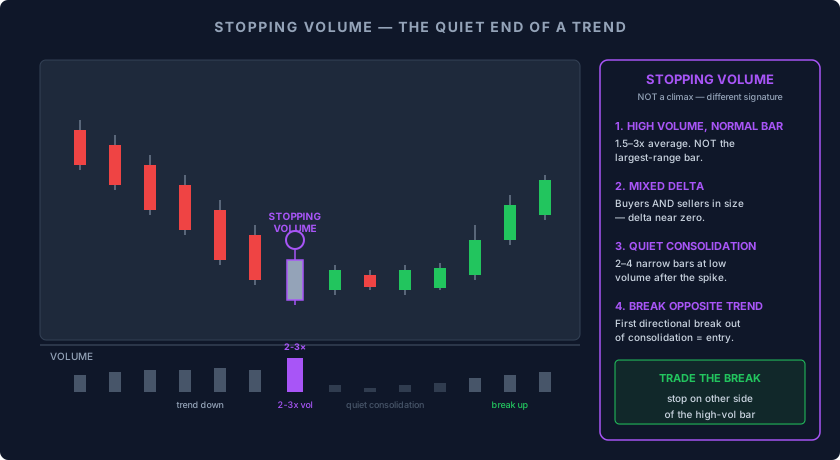
WyckoffDefinitionRichard Wyckoff's analytical framework — accumulation/markup/distribution/markdown phases. Foundation of stopping volume, absorption, effort vs result. named this concept a century ago. It still works because the underlying mechanic — institutions absorbing aggressive flow — has not changed.
How Stopping Volume Differs from Climax
Both involve high volume. Both end trends. The difference is the price reaction:
| Feature | Climax | Stopping VolumeDefinitionWyckoff concept — high volume that halts a trend without immediate reversal. Followed by narrow consolidation, then break in the opposite direction. | |---|---|---| | Volume | 2–5x average, single huge bar | 1.5–3x average, sometimes 2–3 bars | | Price reaction | Sharp reversal within 1–2 bars | Halt and sideways, then reversal over several bars | | Emotion | Maximum fear or greed | Cold and methodical | | Where it happens | Often at the very end of a multi-day trend | Often at the end of an intraday leg or daily move | | Visual | Long wick on climax bar, big reversal candle next | Multiple bars compressing in a tight range after the spike |
If a climax is a heart attack, stopping volumeDefinitionWyckoff concept — high volume that halts a trend without immediate reversal. Followed by narrow consolidation, then break in the opposite direction. is a slow exhale.
The Footprint Signature
Stopping volumeDefinitionWyckoff concept — high volume that halts a trend without immediate reversal. Followed by narrow consolidation, then break in the opposite direction. looks like this on the footprint:
- A bar with noticeably higher volume than recent bars (1.5–3x average)
- The bar may be ordinary in price range — not necessarily the largest bar
- Heavy two-sided activity rather than overwhelmingly one-sided — buyers AND sellers are both there in size
- Delta is mixed or near zero despite the high volume
- Subsequent bars show *low* volume and *narrow* range — the trend has stopped
The narrow-range follow-through is the confirmation. If a high-volume barDefinitionBars that close after a fixed quantity of contracts traded. Rarely used by discretionary traders. is followed by 3 quiet, narrow bars sitting in roughly the same area, that is stopping volumeDefinitionWyckoff concept — high volume that halts a trend without immediate reversal. Followed by narrow consolidation, then break in the opposite direction..
Why It Works
When a trend has been running, retail traders pile in late chasing the move. Aggressive market orders pour in from the trend-followers. Institutional traders who see the trend exhausting step in on the OTHER side with enough resting size to absorb it all.
The result: huge volume (because aggressive ordersDefinitionA market order that crosses the spread to execute immediately. Consumes liquidity. Pays the spread for immediacy. are still pouring in) but no price progress (because institutional passive size is absorbing). The aggressive flow gets soaked up. Once it stops, there is nobody left to push the trend further. The institutions then start nudging price back the other way and the reversal unfolds.
How to Spot It in Real Time
Watch for this sequence:
- A trend has been running for several bars
- A bar with abnormally high volume prints — but it is not the largest-range barDefinitionBars that close after price moves a fixed amount. Uniform bar size produces cleaner footprint signatures. Best for execution.
- The bar's deltaDefinitionAsk volume minus bid volume. Positive = more buying. Negative = more selling. Shows who is more aggressive. is surprisingly mixed (high volume but balanced bidDefinitionThe highest price someone is currently willing to pay to buy. If you sell at market, this is what you get./askDefinitionThe lowest price someone is currently willing to sell at. If you buy at market, this is what you pay.)
- The next 2–4 bars print with much lower volume in a narrow range near the high-volume barDefinitionBars that close after a fixed quantity of contracts traded. Rarely used by discretionary traders.
- The first directional break out of that consolidation is in the OPPOSITE direction of the prior trend
That sequence is the canonical stopping-volume reversal.
How to Trade Stopping Volume
Stopping volumeDefinitionWyckoff concept — high volume that halts a trend without immediate reversal. Followed by narrow consolidation, then break in the opposite direction. gives you time to plan. Unlike climaxes, you do not need to enter immediately — the price action goes sideways for a few bars, giving you a chance to set up.
Setup:
- Wait for the high-volume barDefinitionBars that close after a fixed quantity of contracts traded. Rarely used by discretionary traders. in the trend
- Mark the bar's high and low as your reference range
- Watch the next several bars consolidate
- Enter on the first directional break out of the consolidation, in the OPPOSITE direction of the prior trend
- Stop on the other side of the high-volume barDefinitionBars that close after a fixed quantity of contracts traded. Rarely used by discretionary traders.
- Target: the prior swing highDefinitionA peak on the chart where price reversed lower. Marks where sellers previously overpowered buyers./low against the trend, then extend with the reversal
This is one of the cleanest reversal setups in order flow because the consolidation phase gives you a structured stop and entry point.
Common Mistakes
- Confusing stopping volumeDefinitionWyckoff concept — high volume that halts a trend without immediate reversal. Followed by narrow consolidation, then break in the opposite direction. with normal pullbacks — pullbacks have lower volume on the pullback bar; stopping volume has HIGHER volume than the trend bars
- Trading the high-volume barDefinitionBars that close after a fixed quantity of contracts traded. Rarely used by discretionary traders. itself — you trade the consolidation BREAK, not the high-volume bar. The bar is the signal; the break is the entry.
- Ignoring the consolidation — if there is no consolidation after the high-volume barDefinitionBars that close after a fixed quantity of contracts traded. Rarely used by discretionary traders. (price keeps trending), it was not stopping volumeDefinitionWyckoff concept — high volume that halts a trend without immediate reversal. Followed by narrow consolidation, then break in the opposite direction.; it was continuation
- Forgetting to confirm with deltaDefinitionAsk volume minus bid volume. Positive = more buying. Negative = more selling. Shows who is more aggressive. — high volume + strong one-sided delta is continuation. High volume + balanced delta is stopping.
Stopping Volume + Other Signals
The highest-conviction reversal trades combine stopping volumeDefinitionWyckoff concept — high volume that halts a trend without immediate reversal. Followed by narrow consolidation, then break in the opposite direction. with other signatures:
- Stopping volumeDefinitionWyckoff concept — high volume that halts a trend without immediate reversal. Followed by narrow consolidation, then break in the opposite direction. + bearish divergenceDefinitionPrice prints a higher high while delta prints a lower high. Buyers losing fuel — sell signal at the new high. on cumulative deltaDefinitionRunning total of buying vs selling across the session. Shows who has been in control overall. = strong reversal short
- Stopping volumeDefinitionWyckoff concept — high volume that halts a trend without immediate reversal. Followed by narrow consolidation, then break in the opposite direction. + naked POCDefinitionPrior-session POCs that price never retested. Act as magnets — price tends to come back to them. overhead getting tested = double confirmation
- Stopping volumeDefinitionWyckoff concept — high volume that halts a trend without immediate reversal. Followed by narrow consolidation, then break in the opposite direction. + absorptionDefinitionHeavy aggressive orders hit a level but price doesn't move — a large passive player is absorbing the flow. on subsequent retest = institutional defense confirmed
When you see two or three of these stack at the same level, the reversal is highly likely.
The Bottom Line
Stopping volumeDefinitionWyckoff concept — high volume that halts a trend without immediate reversal. Followed by narrow consolidation, then break in the opposite direction. is the quiet end of a trend. Institutions absorbed everything the crowd threw at the move, and now the move has nowhere to go. The high-volume barDefinitionBars that close after a fixed quantity of contracts traded. Rarely used by discretionary traders. is the marker. The narrow consolidation after is the confirmation. The break of that consolidation is the trade.
Look for it at the end of intraday legs and daily trends. It is more common than climaxes and less risky to trade because the consolidation gives you time to prepare.