Why Imbalances Are the Key to Profitability
A balanced market is a chop zone. When buyers and sellers are roughly equal at every price level, there is no conviction, no direction, and no edge. Price grinds sideways, stops get hit on both sides, and traders bleed out from commissions and slippageDefinitionWhen your fill price differs from the price you saw. Common on market orders in fast markets..
ImbalancesDefinitionA price level where one side overwhelms the other by 3:1 or more. Shows where big players committed. are the opposite of balance. They are the engine that drives trends, breakouts, and every significant price move you see on a chart. Without aggressive participantsDefinitionA market order that crosses the spread to execute immediately. Consumes liquidity. Pays the spread for immediacy. overwhelming the other side, price simply does not move.
A balanced market chops. An imbalanced market trends. Every profitable trade you have ever taken happened because one side overwhelmed the other. ImbalancesDefinitionA price level where one side overwhelms the other by 3:1 or more. Shows where big players committed. are not just a signal — they are the reason price moves at all.
Think of it this way: if 100 buyers and 100 sellers show up at the same price, the market goes nowhere. But if 400 buyers show up and only 100 sellers are there, price moves up — fast. That 4:1 ratio is an imbalanceDefinitionA price level where one side overwhelms the other by 3:1 or more. Shows where big players committed., and it is exactly what the footprint chartDefinitionA chart showing bid and ask volume at every price inside each candle. Reveals who is buying and selling. shows you at every single price level.
How to Spot Imbalances
An imbalanceDefinitionA price level where one side overwhelms the other by 3:1 or more. Shows where big players committed. occurs when one side overwhelms the other at a specific price level. The standard threshold is 3:1 — when the askDefinitionThe lowest price someone is currently willing to sell at. If you buy at market, this is what you pay. volume is three times or more the bidDefinitionThe highest price someone is currently willing to pay to buy. If you sell at market, this is what you get. volume, that is a buying imbalance. When the bid volume is three times or more the ask volume, that is a selling imbalance.
Why imbalancesDefinitionA price level where one side overwhelms the other by 3:1 or more. Shows where big players committed. matter:
- They mark the exact prices where institutional traders committed size
- Retail does not move the tapeDefinitionTrader slang for time and sales — the running stream of executed trades. 'Reading the tape' = inferring direction from prints. 3:1 at a single price level — these are large participant orders
- Trading in the direction of imbalancesDefinitionA price level where one side overwhelms the other by 3:1 or more. Shows where big players committed. means trading with institutional flow, not against it
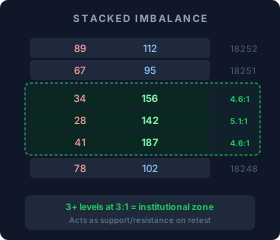
- Stacked imbalancesDefinition3+ consecutive price levels where one side overwhelms the other by 3:1. Marks institutional zones. at a key level tell you smart money is committing to that direction
A single imbalanceDefinitionA price level where one side overwhelms the other by 3:1 or more. Shows where big players committed. at one price level can be noise. But when you see three or more consecutive price levels with imbalances in the same direction — that is a stacked imbalanceDefinition3+ consecutive price levels where one side overwhelms the other by 3:1. Marks institutional zones., and it is one of the most reliable signals in order flow trading.
Stacked imbalancesDefinition3+ consecutive price levels where one side overwhelms the other by 3:1. Marks institutional zones. are institutional footprints. Three or more consecutive price levels with 3:1 or greater volume skew means someone with size committed to that zone. When price returns to a stacked imbalance zone, it acts as support or resistance because the original participants will defend their position.
Stacked buying imbalancesDefinitionA price level where one side overwhelms the other by 3:1 or more. Shows where big players committed. create demand zonesDefinitionA price area where buyers previously overwhelmed sellers. Expect buying when price returns here. below the current price. When price pulls back to that zone, expect buyers to re-engage. Stacked selling imbalances create supply zonesDefinitionA price area where sellers previously overwhelmed buyers. Expect selling when price returns here. above the current price. When price pushes up to that zone, expect sellers to defend.