
Why Combine the Two?
Footprint and volume profile are two views of the same data — order flow at price levels. They differ in *time scope*:
- The footprint shows the volume distributionDefinitionPhase 3 of Power of 3. The real move — Smart Money distributes into retail momentum. INSIDE a single bar (intra-bar detail)
- The volume profile shows the volume distributionDefinitionPhase 3 of Power of 3. The real move — Smart Money distributes into retail momentum. ACROSS an entire session (or multiple sessions)
Used together, they answer two questions a single tool cannot answer alone:
- *Where* are the levels that matter? (volume profile)
- *What is happening* at those levels right now? (footprint)
The combination is the professional workflow for high-conviction execution at high-conviction levels.
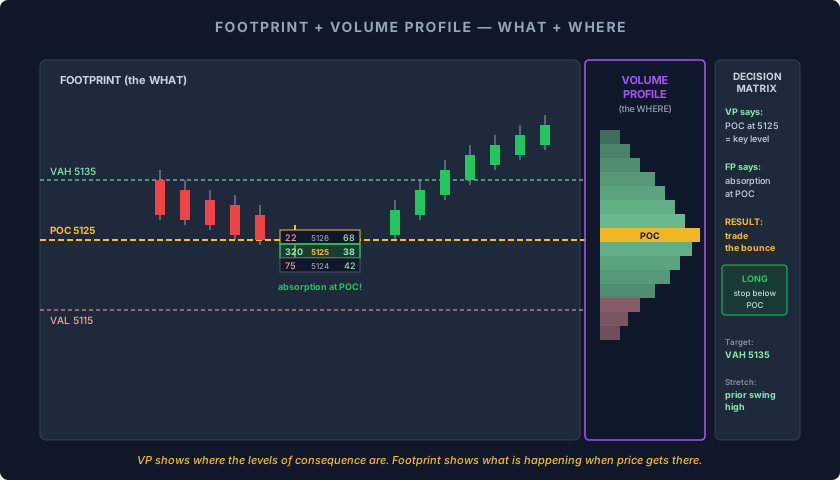
This is also sometimes called the "what + where" workflow.
What the Volume Profile Tells You
A session volume profile shows where price has spent the most time-weighted activity:
- POCDefinitionPoint of Control — the price with the highest volume. Where the most trading happened. — the highest-volume price (where the most contracts traded)
- Value AreaDefinitionThe price range where 70% of volume traded. Defined by Value Area High (VAH) and Value Area Low (VAL). (VA) — the price range containing 70% of the volume
- VAHDefinitionValue Area High — the upper boundary of the zone where 70% of volume traded. Acts as resistance. / VALDefinitionValue Area Low — the lower boundary of the zone where 70% of volume traded. Acts as support. — the upper and lower bounds of the value area
- Volume nodes (HVNDefinitionHigh-Volume Node — price area with heavy resting interest. Acts as support/resistance.) — local high-volume areas where price paused
- Volume gaps (LVNDefinitionLow-Volume Node — price area with minimal resting interest. Price moves through fast.) — local low-volume areas where price moved fast
These are the *levels of consequence*. Price tends to pause at HVNsDefinitionHigh-Volume Node — price area with heavy resting interest. Acts as support/resistance., accelerate through LVNsDefinitionLow-Volume Node — price area with minimal resting interest. Price moves through fast., and gravitate back to the POCDefinitionPoint of Control — the price with the highest volume. Where the most trading happened..
What the Footprint Tells You at Those Levels
The footprint reveals what's happening when price *reaches* one of those volume-profile levels:
- Is there absorptionDefinitionHeavy aggressive orders hit a level but price doesn't move — a large passive player is absorbing the flow.? (large passive buyers/sellers defending)
- Is there exhaustionDefinitionWhen a price extreme is reached but the aggressive volume that should be driving it is missing. Classic reversal signal — the move ran out of participants.? (the move has run out of fuel)
- Are there stacked imbalancesDefinition3+ consecutive price levels where one side overwhelms the other by 3:1. Marks institutional zones.? (institutional aggression)
- Is deltaDefinitionAsk volume minus bid volume. Positive = more buying. Negative = more selling. Shows who is more aggressive. diverging from price?
The volume profile says "watch THIS level." The footprint says "here's what to do when price gets there."
The Combined Workflow
A clean session uses both tools in sequence:
Step 1 — Pre-session: build your level map (volume profile only)
- Mark prior day POCDefinitionPoint of Control — the price with the highest volume. Where the most trading happened., VAHDefinitionValue Area High — the upper boundary of the zone where 70% of volume traded. Acts as resistance., VALDefinitionValue Area Low — the lower boundary of the zone where 70% of volume traded. Acts as support.
- Mark current day's developing POCDefinitionPoint of Control — the price with the highest volume. Where the most trading happened. and VA (will update during session)
- Mark naked POCsDefinitionPrior-session POCs that price never retested. Act as magnets — price tends to come back to them. from previous sessions
- Mark composite POCs from multi-day balance areas
- Identify HVNDefinitionHigh-Volume Node — price area with heavy resting interest. Acts as support/resistance. clusters and LVNDefinitionLow-Volume Node — price area with minimal resting interest. Price moves through fast. gaps
These are the *only* levels that matter. Everything else is noise.
Step 2 — During session: monitor for level approach (volume profile + footprint)
- Watch as price approaches one of your marked levels
- Switch attention to the footprint as price arrives at the level
- Look for absorptionDefinitionHeavy aggressive orders hit a level but price doesn't move — a large passive player is absorbing the flow., exhaustionDefinitionWhen a price extreme is reached but the aggressive volume that should be driving it is missing. Classic reversal signal — the move ran out of participants., stacked imbalancesDefinition3+ consecutive price levels where one side overwhelms the other by 3:1. Marks institutional zones., deltaDefinitionAsk volume minus bid volume. Positive = more buying. Negative = more selling. Shows who is more aggressive. divergence
Step 3 — Execute: trade the level reaction (footprint primary)
- Enter when the footprint confirms the level holds (or fails)
- Stop on the other side of the level
- Target the next level (defined by the volume profile)
This sequence — *VP for the level, footprint for the entry, VP for the target* — is the cleanest workflow in order flow trading.
Specific Setups
The POCDefinitionPoint of Control — the price with the highest volume. Where the most trading happened. Defense Long. Price approaches the prior session POC from above (now acting as support). Footprint at the POC shows absorptionDefinitionHeavy aggressive orders hit a level but price doesn't move — a large passive player is absorbing the flow. (large bidDefinitionThe highest price someone is currently willing to pay to buy. If you sell at market, this is what you get. not dropping). Long with stop below POC, target the prior session VAHDefinitionValue Area High — the upper boundary of the zone where 70% of volume traded. Acts as resistance..
The Value AreaDefinitionThe price range where 70% of volume traded. Defined by Value Area High (VAH) and Value Area Low (VAL). Rejection. Price tries to break above the value area high but the footprint shows exhaustionDefinitionWhen a price extreme is reached but the aggressive volume that should be driving it is missing. Classic reversal signal — the move ran out of participants. + stacked sell imbalancesDefinitionA price level where one side overwhelms the other by 3:1 or more. Shows where big players committed. at the VAHDefinitionValue Area High — the upper boundary of the zone where 70% of volume traded. Acts as resistance. extension. Short the failed breakout, target back toward POCDefinitionPoint of Control — the price with the highest volume. Where the most trading happened..
The LVNDefinitionLow-Volume Node — price area with minimal resting interest. Price moves through fast. Pierce. Price approaches a low-volume gapDefinitionSynonym for Low-Volume Node — a section of the volume profile with little resting size. on the profile. Footprint shows aggressive flow accelerating through. Trade with the breakout because the LVN means there's no resting size to slow the move. Target the next HVNDefinitionHigh-Volume Node — price area with heavy resting interest. Acts as support/resistance. above (or below).
The Naked POCDefinitionPrior-session POCs that price never retested. Act as magnets — price tends to come back to them. Test. A naked POC from a prior session sits in the path of current price. Watch the footprint as price approaches — absorptionDefinitionHeavy aggressive orders hit a level but price doesn't move — a large passive player is absorbing the flow. + reversal = trade against the magnet, exhaustionDefinitionWhen a price extreme is reached but the aggressive volume that should be driving it is missing. Classic reversal signal — the move ran out of participants. + breakthrough = trade with the magnet.
Composite Profiles for Bigger Levels
For multi-day work, use composite profilesDefinitionMultiple sessions combined into one profile. Composite POCs and Value Areas carry more weight than single sessions. — volume profiles aggregated across multiple sessions (e.g., the last 5 days or the last week).
Composite profilesDefinitionMultiple sessions combined into one profile. Composite POCs and Value Areas carry more weight than single sessions. reveal the *bigger* structural levels:
- Composite POCDefinitionPOC of a multi-session composite profile. Carries more weight than any single-session POC. — the most-traded price across the entire period
- Composite VAHDefinitionValue Area High — the upper boundary of the zone where 70% of volume traded. Acts as resistance./VALDefinitionValue Area Low — the lower boundary of the zone where 70% of volume traded. Acts as support. — the multi-day value area boundaries
- Composite naked POCsDefinitionPrior-session POCs that price never retested. Act as magnets — price tends to come back to them. — sessions whose POCDefinitionPoint of Control — the price with the highest volume. Where the most trading happened. was never tested in the period
Composite levels are stronger than single-session levels because they represent sustained two-sided interest, not just one day's noise.
The same workflow applies: composite profileDefinitionMultiple sessions combined into one profile. Composite POCs and Value Areas carry more weight than single sessions. gives you the level, footprint gives you the entry. The trades just have larger targets and longer hold times.
The "What + Where" Decision Matrix
Use this matrix to decide what to do at any moment:
| Where price is | What footprint shows | Action | |---|---|---| | At a key VP level | AbsorptionDefinitionHeavy aggressive orders hit a level but price doesn't move — a large passive player is absorbing the flow. / divergence / exhaustionDefinitionWhen a price extreme is reached but the aggressive volume that should be driving it is missing. Classic reversal signal — the move ran out of participants. | Trade the reversal | | At a key VP level | Strong continuation flow | Trade with the breakout | | Inside an LVNDefinitionLow-Volume Node — price area with minimal resting interest. Price moves through fast. gap | Strong directional flow | Trade with the move (no resistance until next HVNDefinitionHigh-Volume Node — price area with heavy resting interest. Acts as support/resistance.) | | Inside an HVN | Mixed / balanced | Wait for one side to commit | | Far from any level | Anything | Stand aside — no edge |
The "far from any level" condition is the one most traders ignore. If you're not at a level, you're not at a high-edge spot. Wait.
Common Mistakes
- Trading the footprint without volume profile context — every footprint signal looks tradable. Filter ruthlessly: only act when the footprint confirms at a known VP level.
- Trading the volume profile without footprint confirmation — levels alone are not setups. The level tells you *where*, the footprint tells you *whether*. Without footprint confirmation, you're guessing.
- Ignoring the LVNDefinitionLow-Volume Node — price area with minimal resting interest. Price moves through fast. gaps — high-volume nodesDefinitionA local high-volume area on the volume profile. Acts as support/resistance; price pauses and reacts at HVNs. get all the attention but the gaps between them are where price moves the fastest. LVN trades are often the cleanest because there's no resting resistance.
- Using only intraday VP — composite VPs reveal levels that single-session VPs miss. Run both.
How to Set Up the Tool
In your charting platform (NinjaTrader, Sierra Chart, etc.):
- Right pane: session volume profile, prior day profile (faded), composite profileDefinitionMultiple sessions combined into one profile. Composite POCs and Value Areas carry more weight than single sessions. (faded)
- Main pane: footprint chartDefinitionA chart showing bid and ask volume at every price inside each candle. Reveals who is buying and selling. (range barsDefinitionBars that close after price moves a fixed amount. Uniform bar size produces cleaner footprint signatures. Best for execution. or low time barsDefinitionBars that close after a fixed time interval. The default for most charting. Best for context, not order-flow execution.)
- Optional: developing POCDefinitionPoint of Control — the price with the highest volume. Where the most trading happened. line extending across the chart, VAHDefinitionValue Area High — the upper boundary of the zone where 70% of volume traded. Acts as resistance./VALDefinitionValue Area Low — the lower boundary of the zone where 70% of volume traded. Acts as support. extending across the chart
- Mark naked POCsDefinitionPrior-session POCs that price never retested. Act as magnets — price tends to come back to them. with extended lines so you see them coming
The visual goal: every important VP level extends across your footprint chartDefinitionA chart showing bid and ask volume at every price inside each candle. Reveals who is buying and selling. so you can see when price is approaching one. The footprint then handles the rest.
The Bottom Line
Volume profile shows you WHERE the levels of consequence are. Footprint shows you WHAT IS HAPPENING when price reaches them. One without the other is a partial picture. Together they form the cleanest, highest-conviction order-flow workflow.
Pre-mark your VP levels. Wait for price to reach them. Read the footprint. Take the trade with confidence — or pass. Either way, you're operating with edge.