
ICT (Inner Circle Trader) concepts are a framework for understanding how institutional traders — banks, hedge funds, and market makers — move price. Instead of relying on lagging indicators, ICT focuses on the mechanics of price delivery: where liquidityDefinitionResting orders (stop losses, limit orders) at known levels. Institutions need liquidity to fill large positions. sits, how it gets swept, and how Smart MoneyDefinitionInstitutional traders — banks, hedge funds, market makers — with the capital to move markets. uses that process to fill large orders.
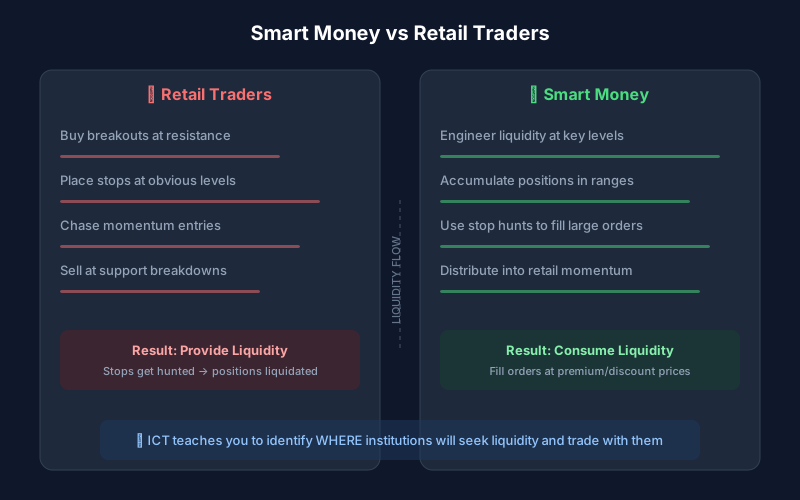
The core idea is simple: retail traders provide liquidityDefinitionResting orders (stop losses, limit orders) at known levels. Institutions need liquidity to fill large positions., and institutions consume it. Every stop lossDefinitionAn automatic exit order. If price moves against you to a preset level, the trade closes automatically. Every trade needs one. you place is someone else's entry. Every breakout you chase was engineered to draw you in.
ICT concepts are not a "system" with fixed rules. They are a framework for reading what institutions are doing with price. Once you understand the mechanics, you can apply them on any instrument and any timeframe.
Why Do Markets Move?
Markets move because of liquidityDefinitionResting orders (stop losses, limit orders) at known levels. Institutions need liquidity to fill large positions.. Large institutional traders need to fill massive orders — thousands of contracts at specific prices. They cannot simply hit the market with a 5,000-lot order because the slippageDefinitionWhen your fill price differs from the price you saw. Common on market orders in fast markets. would destroy their entry.
Instead, they engineer liquidityDefinitionResting orders (stop losses, limit orders) at known levels. Institutions need liquidity to fill large positions.. They push price into zones where retail traders have placed their stop losses. When those stops get triggered, they create a burst of orders (liquidity) that institutions use to fill their positions at favorable prices.
This is why price "always seems to take out your stop before going your way." It is not bad luck — it is by design.
The Five Core ICT Concepts
This course covers the five pillars of ICT methodology:
1. Liquidity
Where are stop losses clustered? Equal highs and equal lows create pools of liquidityDefinitionResting orders (stop losses, limit orders) at known levels. Institutions need liquidity to fill large positions. that institutions target. Understanding liquidity is the foundation — it tells you where price is going next.
2. Order Blocks
Order blocksDefinitionThe last opposing candle before an impulse move. Where the institutional order that started the move originated. are the zones where institutional orders originated. They mark the last opposing candle before a strong impulse move. When price returns to an order block, it often reacts because unfilled orders are still sitting there.
3. Fair Value Gaps (FVGs)
FVGsDefinitionFair Value Gap — a three-candle pattern where the wick of Candle 1 doesn't overlap with the wick of Candle 3. Price tends to return to fill these gaps. are price inefficiencies — areas where price moved so fast that not all orders could be filled. These gaps act as magnets, pulling price back to rebalance before continuing the trend.
4. Killzones
Not all hours are created equal. ICT killzonesDefinitionTime windows when institutions are most active: London Open (2-5am ET), NY Open (7-10am ET). identify the specific trading sessions where institutional activity is highest — London OpenDefinition2-5am ET killzone. Where the daily manipulation (Judas Swing) typically begins., New York Open, and the overlap. Trading during killzones dramatically improves your win rate.
5. Power of 3 (AMD)
The AccumulationDefinitionPhase 1 of Power of 3. Price consolidates while Smart Money quietly builds positions. → ManipulationDefinitionPhase 2 of Power of 3. Fake breakout that sweeps liquidity — the Judas Swing. → DistributionDefinitionPhase 3 of Power of 3. The real move — Smart Money distributes into retail momentum. cycle explains how every move is structured. Smart MoneyDefinitionInstitutional traders — banks, hedge funds, market makers — with the capital to move markets. accumulates in a range, manipulates price to sweep liquidityDefinitionResting orders (stop losses, limit orders) at known levels. Institutions need liquidity to fill large positions., then distributes in the true direction.
How ICT Connects to Order Flow
ICT concepts tell you where to look. Order flow tells you what is actually happening at those levels. When you combine ICT levels (order blocksDefinitionThe last opposing candle before an impulse move. Where the institutional order that started the move originated., FVGsDefinitionFair Value Gap — a three-candle pattern where the wick of Candle 1 doesn't overlap with the wick of Candle 3. Price tends to return to fill these gaps., liquidityDefinitionResting orders (stop losses, limit orders) at known levels. Institutions need liquidity to fill large positions. zones) with footprint analysis (imbalancesDefinitionA price level where one side overwhelms the other by 3:1 or more. Shows where big players committed., deltaDefinitionAsk volume minus bid volume. Positive = more buying. Negative = more selling. Shows who is more aggressive., absorptionDefinitionHeavy aggressive orders hit a level but price doesn't move — a large passive player is absorbing the flow.), you get confirmation that the institutional narrative is playing out in real-time.
For example: price pulls back to a bullish order blockDefinitionThe last opposing candle before an impulse move. Where the institutional order that started the move originated. during the NY killzoneDefinitionTime windows when institutions are most active: London Open (2-5am ET), NY Open (7-10am ET).. Your footprint chartDefinitionA chart showing bid and ask volume at every price inside each candle. Reveals who is buying and selling. shows absorptionDefinitionHeavy aggressive orders hit a level but price doesn't move — a large passive player is absorbing the flow. — heavy selling being absorbed by passive buyers. That is the ICT concept (order block + killzone) confirmed by order flow (absorption). That is a high-probability entry.