
Auction market theoryDefinitionMarkets alternate between balance (rotation) and imbalance (trending). Determines your strategy. classifies four open types ranked by directional conviction. Where price opens relative to value tells you the starting condition. The open type tells you how much conviction is behind it. Recognizing the open type early — often within the first 15 minutes — helps you decide whether to trade aggressively, wait for confirmation, or sit on your hands entirely.
The open type is your first read of the session. Open-Drive says "this is a trend dayDefinitionA session where price moves persistently in one direction. Typically signaled by narrow IB + strong extension. Trade with the trend. — get in." Open-Auction says "nobody knows yet — wait for a signal." Matching your aggression to the open type keeps you out of low-conviction trades.
Open-Drive
The highest conviction open. Price opens and drives aggressively in one direction with no significant pullback to the opening price. Other Time Frame (OTF) participants made their decision before the bell — they are executing, not exploring.
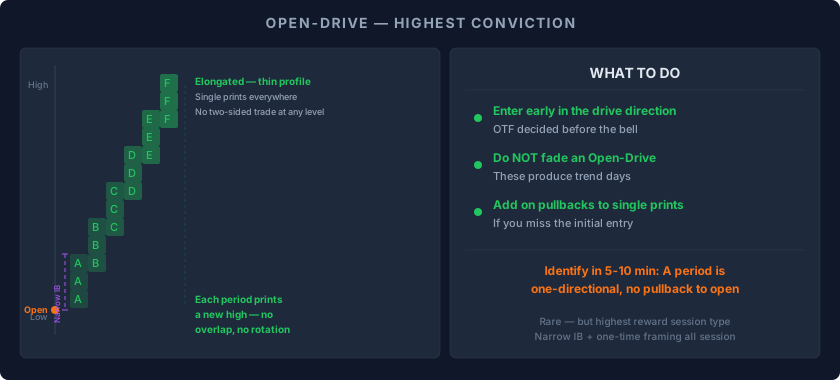
- Do not fade an Open-Drive — enter in the direction of the drive as early as possible
- Associated with narrow Initial Balance and one-time framing all session
- If you miss the entry, wait for a shallow pullback to single prints and add there
- Open-Drives produce trend days — the profile will be elongated with minimal two-sided trade
- These are rare. When they happen, they are the highest-reward session type
An Open-Drive is the market telling you with maximum clarity: one side has total control. The only mistake you can make is fading it or waiting too long to get in.
Open-Test-Drive
Second-highest conviction. Price opens, probes beyond a known reference level (prior high, low, VA edge) to test whether new business exists in that direction, then reverses and drives aggressively back through the opening price.
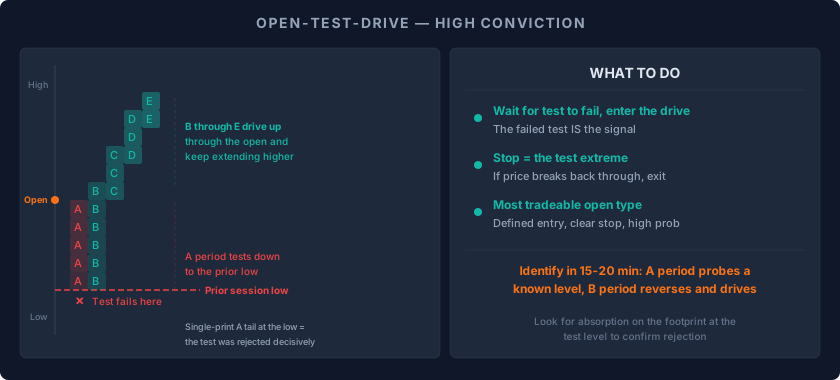
- The failed test of the reference level is your signal — enter when the drive begins
- The test confirms that no value exists at the extreme, so the market is free to move the other way
- High-probability setup with a clear invalidation point (the test extreme)
- The test usually happens in the A or B period, and the drive develops through the rest of the session
- Combine with footprint confirmation — look for absorption at the test level (aggressive ordersDefinitionA market order that crosses the spread to execute immediately. Consumes liquidity. Pays the spread for immediacy. being absorbed by passive participantsDefinitionA resting limit order on the DOM that provides liquidity. Doesn't pay the spread — but may not get filled.)
The Open-Test-Drive is the most tradeable open type. The test gives you a clear reference level, the drive gives you direction, and the invalidation point (the test extreme) gives you a defined stop. Wait for the test to fail, then trade the drive.
Open-Rejection-Reverse
Moderate conviction. Price opens and moves in one direction but encounters opposing force strong enough to reverse it back through the opening rangeDefinitionThe high-low range of the first N minutes of RTH (commonly 5, 15, 30, or 60). The 60-minute opening range is the Initial Balance.. The initial probe was exploratory, not committed.
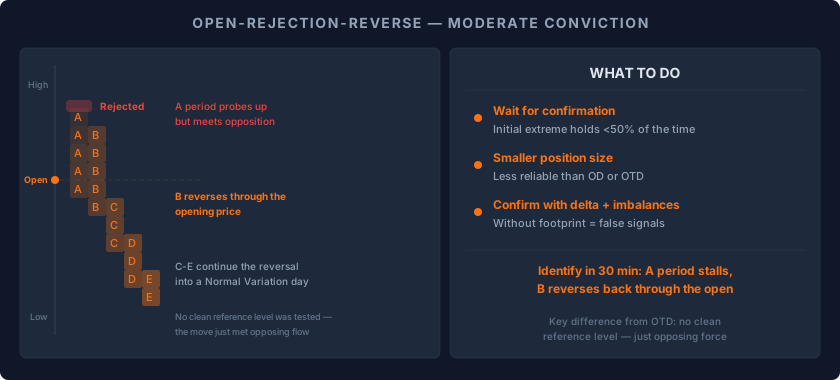
- Wait for the rejection to develop and the reversal to confirm before entering
- Use smaller position size — the initial extreme holds less than half the time
- Confirmation from delta and imbalances at the reversal point improves the odds significantly
- The key difference from Open-Test-Drive: in ORR, the initial move does not reach a well-defined reference level. It just runs into opposing flow
- Less reliable, but when confirmed by order flow, it produces solid Normal Variation days
The Open-Rejection-Reverse requires patience. Do not jump in at the first sign of reversal — wait for the footprint to show you that the opposing side has real conviction. Without confirmation, this open type generates the most false signals.
Open-Auction
Lowest conviction. Price opens inside previous value and auctions back and forth with no clear directional bias. OTF participants have not yet revealed their hand. This is the most common open type.
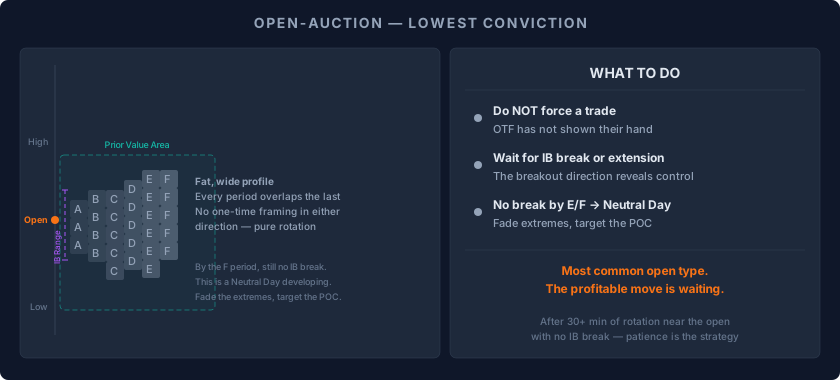
- Do not force a directional trade early — patience is the strategy
- Wait for range extension later in the session to reveal which side has taken control
- If neither side breaks the IB by the E or F period, it is likely a Neutral Day — trade responsively within the range
- Open-Auction sessions often produce Normal or Neutral day types
- The longer price stays inside value without breaking the IB, the more likely it is a range dayDefinitionA session where price oscillates within a range. Typically signaled by average IB + no extension. Fade extremes.
The Open-Auction is the market saying "we do not know yet." The worst thing you can do is force a directional trade into an Open-Auction. Wait for the market to tell you — it always does, eventually. The traders who profit from Open-Auction sessions are the ones who wait for the IB break and then follow the range extensionDefinitionWhen price breaks beyond the Initial Balance. If it extends 1x IB range, expect continuation..
Identifying the Open Type in Real-Time
You do not need to wait until the end of the day to classify the open type. Here is how to identify each one as it develops:
- Open-Drive: Within the first 5-10 minutes, price has moved aggressively in one direction with no pullback to the opening tick. The A period is one-directional. By the time the B period starts, price has not revisited the opening price
- Open-Test-Drive: Within the first 15-20 minutes, price probes a known level (you should have these marked from the prior session), gets rejected, and begins driving the other way through the open
- Open-Rejection-Reverse: Within the first 30 minutes, price moved in one direction, stalled, and is now reversing back through the opening rangeDefinitionThe high-low range of the first N minutes of RTH (commonly 5, 15, 30, or 60). The 60-minute opening range is the Initial Balance.. There is no clean reference level involved — it just met opposition
- Open-Auction: After 30+ minutes, price is still rotating near the open with no clear direction. The A and B periods overlap significantly. The IB is forming as a balanced range
Mark your prior session's POCDefinitionPoint of Control — the price with the highest volume. Where the most trading happened., VAHDefinitionValue Area High — the upper boundary of the zone where 70% of volume traded. Acts as resistance., VALDefinitionValue Area Low — the lower boundary of the zone where 70% of volume traded. Acts as support., high, low, and any poor highs or poor lows before the open. These are the reference levels that distinguish an Open-Test-Drive from an Open-Rejection-Reverse. Without these levels marked, you are guessing.