
The Initial BalanceDefinitionThe price range of the first hour (A + B periods). Narrow IB = trend day. Wide IB = range day. (IB) is the highest and lowest prices reached during the first hour of RTHDefinitionRegular Trading Hours — 9:30 AM to 4:00 PM ET. Where 80-90% of daily futures volume happens. The main session traders focus on..
- RTHDefinitionRegular Trading Hours — 9:30 AM to 4:00 PM ET. Where 80-90% of daily futures volume happens. The main session traders focus on. opens at 9:30 AM ET
- RTHDefinitionRegular Trading Hours — 9:30 AM to 4:00 PM ET. Where 80-90% of daily futures volume happens. The main session traders focus on.'s first hour ends at 10:30 AM ET
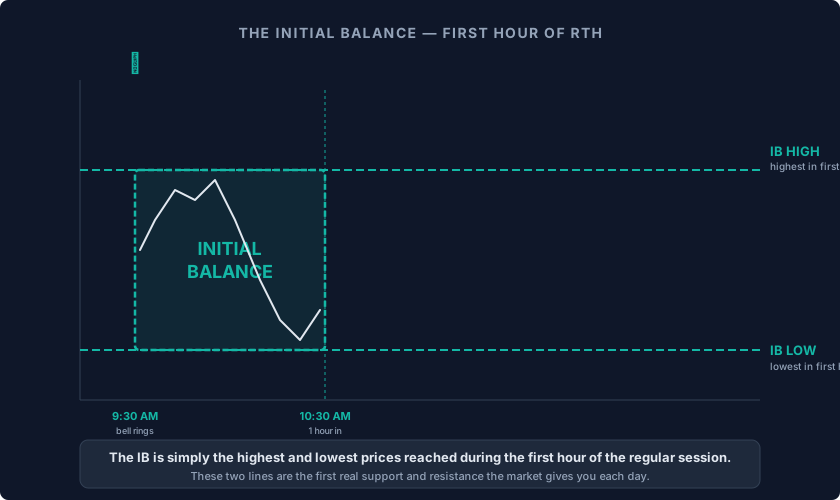
- Whatever high and low price formed between those two times is the Initial BalanceDefinitionThe price range of the first hour (A + B periods). Narrow IB = trend day. Wide IB = range day.
The IB HighDefinitionInitial Balance High — the highest price reached in the first hour of RTH (9:30-10:30 AM ET). and IB LowDefinitionInitial Balance Low — the lowest price reached in the first hour of RTH (9:30-10:30 AM ET). are simply those two prices drawn as horizontal lines on your chart.
Why the First Hour Matters So Much
The opening bell unleashes a huge wave of participation:
- Overnight traders rebalance their positions
- Institutional orders start flowing
- Retail traders who were asleep are now awake and active
- News that came out during the night gets priced in
All of that energy is concentrated into the first 60 minutes of RTHDefinitionRegular Trading Hours — 9:30 AM to 4:00 PM ET. Where 80-90% of daily futures volume happens. The main session traders focus on.. By 10:30 AM, the market has had time to settle and show its hand. The range it built in that hour is the market's first vote about where price is comfortable.
Whatever high and low that vote produced becomes the day's first real support and resistance.
IB High and IB Low — the Day's First Levels
For the rest of the trading day, the IB HighDefinitionInitial Balance High — the highest price reached in the first hour of RTH (9:30-10:30 AM ET). and IB LowDefinitionInitial Balance Low — the lowest price reached in the first hour of RTH (9:30-10:30 AM ET). are two of the most-watched levels on every professional trader's chart.
- IB HighDefinitionInitial Balance High — the highest price reached in the first hour of RTH (9:30-10:30 AM ET). = the ceiling of the first hour's vote
- IB LowDefinitionInitial Balance Low — the lowest price reached in the first hour of RTH (9:30-10:30 AM ET). = the floor of the first hour's vote
You can think of them the same way you think of PDHDefinitionPrior Day High — the highest price from yesterday's RTH session. A key level every trader watches. and PDLDefinitionPrior Day Low — the lowest price from yesterday's RTH session. A key level every trader watches. — levels where buyers or sellers gave up. Except PDH and PDL are yesterday's votes, and the IB is today's vote, built in real time.
What Usually Happens Next
After 10:30 AM, price does one of three things:
1. Price stays inside the IB
The simplest outcome. The market is balanced — it voted on a range in the first hour and is comfortable staying there. These are often called range days or balance days.
Traders in this case fade the extremes: buy near IB LowDefinitionInitial Balance Low — the lowest price reached in the first hour of RTH (9:30-10:30 AM ET)., sell near IB HighDefinitionInitial Balance High — the highest price reached in the first hour of RTH (9:30-10:30 AM ET)., and watch for chop in the middle.
2. Price breaks out of the IB (Range Extension)
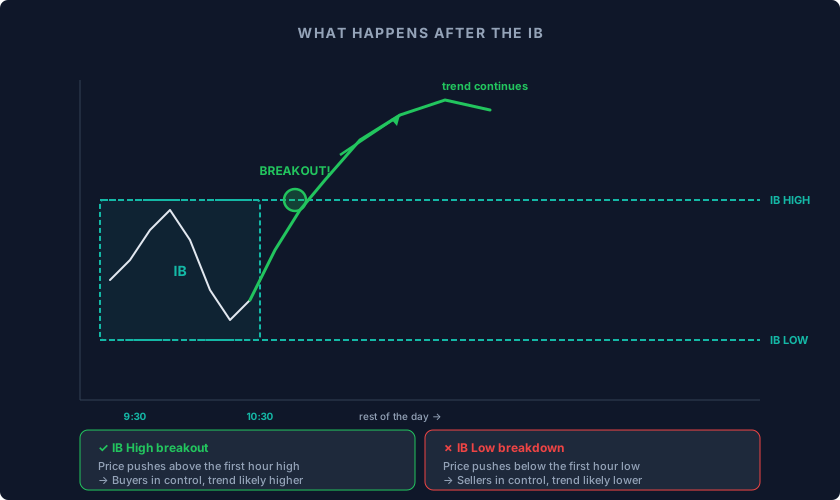
Price pushes above IB HighDefinitionInitial Balance High — the highest price reached in the first hour of RTH (9:30-10:30 AM ET). or below IB LowDefinitionInitial Balance Low — the lowest price reached in the first hour of RTH (9:30-10:30 AM ET). and keeps going. This is called a range extensionDefinitionWhen price breaks beyond the Initial Balance. If it extends 1x IB range, expect continuation. and it tells you the market is no longer balanced — buyers or sellers took control after the initial vote.
A common target traders watch for after a range extensionDefinitionWhen price breaks beyond the Initial Balance. If it extends 1x IB range, expect continuation. is the 1× target: add the full IB range to the breakout point.
- If the IB is 20 points wide and price breaks above IB HighDefinitionInitial Balance High — the highest price reached in the first hour of RTH (9:30-10:30 AM ET). → many traders watch for a 20-point move above IB High
- If the IB is 20 points wide and price breaks below IB LowDefinitionInitial Balance Low — the lowest price reached in the first hour of RTH (9:30-10:30 AM ET). → many traders watch for a 20-point move below IB Low
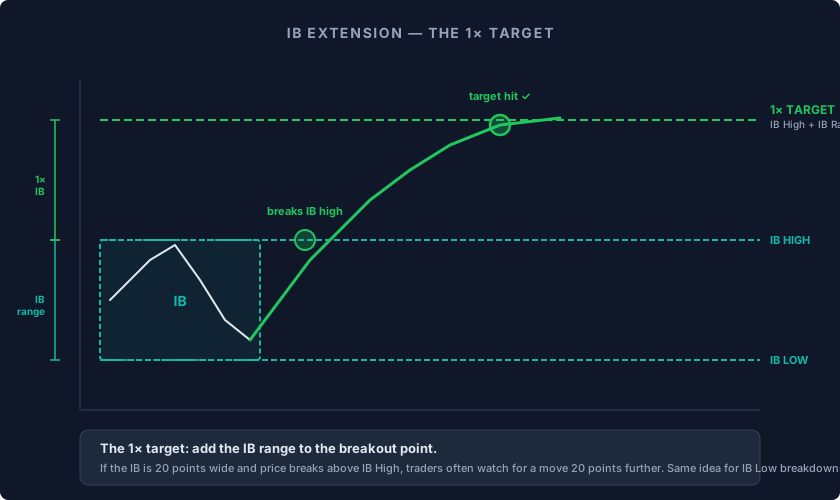
This is not a guaranteed target. It is a commonly-watched reference point — which is exactly why it tends to act as one. When enough traders watch the same level, their orders give it weight.
3. The Failed Breakout and the First Retest
This is the one worth paying extra attention to.
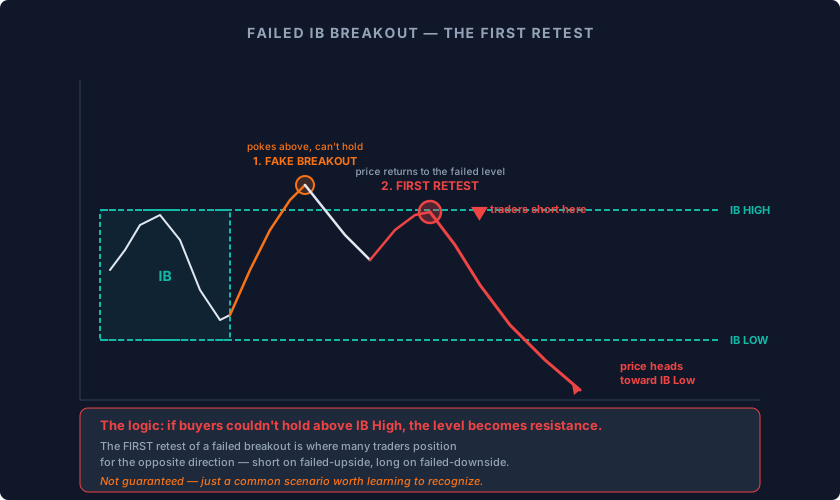
Sometimes price pokes above IB HighDefinitionInitial Balance High — the highest price reached in the first hour of RTH (9:30-10:30 AM ET). (or below IB LowDefinitionInitial Balance Low — the lowest price reached in the first hour of RTH (9:30-10:30 AM ET).) but cannot hold. Within a few minutes it slides back inside the IB. This is a failed breakout — the direction was tested, the market rejected it.
When this happens, many traders watch for the first retest of the level that failed.
The logic:
- Buyers pushed above IB HighDefinitionInitial Balance High — the highest price reached in the first hour of RTH (9:30-10:30 AM ET). and couldn't keep it
- That attempt just ran the stops of anyone short above the level
- Now there are no more buyers left to push — and plenty of trapped longs waiting to get out
- The first time price drifts back up to that IB HighDefinitionInitial Balance High — the highest price reached in the first hour of RTH (9:30-10:30 AM ET)., it often gets rejected again
- Traders use that rejection to go short, riding the disappointment back toward IB LowDefinitionInitial Balance Low — the lowest price reached in the first hour of RTH (9:30-10:30 AM ET). or beyond
The same logic works in reverse on failed downside breakouts: failed break below IB LowDefinitionInitial Balance Low — the lowest price reached in the first hour of RTH (9:30-10:30 AM ET). → price returns up to test IB Low from below → many traders go long on that first retest, expecting a reversal back into the IB range.
This is not guaranteed. Failed breakouts sometimes lead to full reversals, and sometimes lead to nothing. But the first retest after a failed breakout is one of the most-watched setups in futures trading — precisely because so many traders know the pattern and position around it.
Why the *first* retest specifically?
- On the first retest, the level is fresh — the memory of the failed break is very recent
- On later retests, the level gets weaker — each additional touch chips away at the sellers (or buyers) defending it
- Eventually, repeated tests of a level tend to break it. The first one is the safest to fade.
Simple Rules for Using the IB
- Mark the IB HighDefinitionInitial Balance High — the highest price reached in the first hour of RTH (9:30-10:30 AM ET). and IB LowDefinitionInitial Balance Low — the lowest price reached in the first hour of RTH (9:30-10:30 AM ET). at 10:30 AM — literally every day. Horizontal lines, clearly drawn
- Watch how price behaves relative to the IB — inside, above, below, and whether it is trending or chopping
- Note when a break fails — that is the setup worth watching
- Combine IB with PDHDefinitionPrior Day High — the highest price from yesterday's RTH session. A key level every trader watches./PDLDefinitionPrior Day Low — the lowest price from yesterday's RTH session. A key level every trader watches. — if IB HighDefinitionInitial Balance High — the highest price reached in the first hour of RTH (9:30-10:30 AM ET). stacks with PDH, that is a much stronger level than either alone
- Do not rush the morning — the IB is not complete until 10:30 AM. Many traders wait for the IB to finish before taking their first trade
A Deeper Lesson Exists
This lesson covers the basics — enough to understand what the IB is, why it matters, and how most day traders use it.
Once you are comfortable with the fundamentals above, check out the deeper lesson in the Market ProfileDefinitionA chart format using TPO letters to show how long price traded at each level. Reveals the shape of the auction. track: Initial BalanceDefinitionThe price range of the first hour (A + B periods). Narrow IB = trend day. Wide IB = range day.: The First Hour Framework. It covers day type classification, narrow vs. wide IB, and the more advanced framework for trading around it.
A Typical Day — Putting It All Together
Now that you have learned about futures contractsDefinitionAn agreement to buy or sell something at a set price on a future date. The foundation of every futures trade., sessions, key levels, and the Initial BalanceDefinitionThe price range of the first hour (A + B periods). Narrow IB = trend day. Wide IB = range day., here is what a clean futures trader's day actually looks like:
- Before the market opens, they mark the key levels on their chart — Prior Day HighDefinitionThe highest price reached during yesterday's RTH session. Often acts as resistance when price approaches today., Prior Day LowDefinitionThe lowest price reached during yesterday's RTH session. Often acts as support when price approaches today., PremarketDefinitionTrading before the 9:30 AM ET open. Light volume, but the highs and lows established here often matter once RTH begins. High, and Premarket LowDefinitionThe lowest price reached during premarket trading (before 9:30 AM ET).
- At 9:30 AM, they watch the RTHDefinitionRegular Trading Hours — 9:30 AM to 4:00 PM ET. Where 80-90% of daily futures volume happens. The main session traders focus on. open and how price reacts to those premarketDefinitionTrading before the 9:30 AM ET open. Light volume, but the highs and lows established here often matter once RTH begins. and prior-day levels
- From 9:30 to 10:30 AM, they mostly observe. The first hour forms the Initial BalanceDefinitionThe price range of the first hour (A + B periods). Narrow IB = trend day. Wide IB = range day. — the day's first real structure
- At 10:30 AM, they mark the IB HighDefinitionInitial Balance High — the highest price reached in the first hour of RTH (9:30-10:30 AM ET). and IB LowDefinitionInitial Balance Low — the lowest price reached in the first hour of RTH (9:30-10:30 AM ET). on their chart. Now they have a complete map of today's key levels
- After 10:30 AM, they watch for clean setups at those levels — a breakout, a rejection, a failed breakout with a first retest
- When a setup triggers, they place a limit orderDefinitionAn order that only fills at your chosen price (or better). Waits until the market reaches your price. or market orderDefinitionAn order to buy or sell RIGHT NOW at whatever price is available. Fastest execution, but you take the current price. to go long or short, with a predefined stop lossDefinitionAn automatic exit order. If price moves against you to a preset level, the trade closes automatically. Every trade needs one. and target
- They accept the outcome — take the profit if the target hits, take the loss if the stop hits
- They repeat this only when a clean setup appears — not on every wiggle
You do not make trades all day long. You wait for the setups you have practiced, and you let the rest of the market pass you by.
Most professionals take 2 to 4 quality trades per day during RTHDefinitionRegular Trading Hours — 9:30 AM to 4:00 PM ET. Where 80-90% of daily futures volume happens. The main session traders focus on. — not 15 impulse trades. The discipline to wait is what separates traders from gamblers.
Common Mistakes
- Trading before the IB completes — the first hour is noisy. Many pros do not take a single trade until after 10:30 AM
- Treating IB HighDefinitionInitial Balance High — the highest price reached in the first hour of RTH (9:30-10:30 AM ET). and IB LowDefinitionInitial Balance Low — the lowest price reached in the first hour of RTH (9:30-10:30 AM ET). as hard walls — they are zones, not exact prices. Give them a few ticks of wiggle room
- Ignoring failed breakouts — a poke above followed by a return inside is one of the most information-rich moves of the day. Do not miss it
- Forgetting IB matters all day — the IB formed in the first hour stays relevant until the 4 PM close, and often beyond