
Market structure is the framework that tells you what the market is doing right now — trending up, trending down, or ranging. It is built on one simple concept: the relationship between swing highsDefinitionA peak on the chart where price reversed lower. Marks where sellers previously overpowered buyers. and swing lowsDefinitionA trough on the chart where price reversed higher. Marks where buyers previously overpowered sellers..
Every chart, on every timeframe, on every instrument, follows the same structural rules. Once you learn to read structure, you can trade anything — NQDefinitionE-mini Nasdaq 100 futures contract. Known for fast, volatile moves. 1 tick = $5, 1 point = $20., ESDefinitionE-mini S&P 500 futures contract. Tracks the S&P 500 index. 1 tick = $12.50, 1 point = $50. Most heavily traded index future., YMDefinitionE-mini Dow Jones futures contract. Less volatile than ES/NQ. 1 tick = $5, 1 point = $5., crude oil, gold — because the language is universal.
Market structure is not an indicator. It is the underlying grammar of price movement. Every indicator, every pattern, every setup is built on top of structure. If you do not understand structure, nothing else matters.
Why Market Structure Matters
Most traders jump straight into indicators, patterns, and setups without understanding the foundation underneath them all. They add RSI, MACD, moving averages — and still lose money. The reason is simple: they are making decisions without knowing whether the market is trending or ranging, and in which direction.
Market structure answers the most fundamental question in trading: who is in control right now — buyers or sellers?
When you can answer that question at a glance, everything else gets easier:
- You know which direction to trade — no more fighting the trend
- You know when a trend is weakening before it reverses
- You know when to stay out because the market has no clear direction
- You can filter out bad setups that go against the prevailing structure
Structure is not a trading strategy by itself. It is the context layer that makes every strategy better. Whether you trade order flow, ICT concepts, supply and demand, or pure price action — all of it works better when you trade in alignment with structure.
The Three States of the Market
At any given moment, the market is in one of three states:
- Bullish structure — higher highs and higher lows. Buyers are in control. Every pullback is a potential buying opportunity
- Bearish structure — lower highs and lower lows. Sellers are in control. Every rally is a potential shorting opportunity
- Ranging structure — roughly equal highs and equal lows. Neither side has control. The market is consolidating, and breakout traders get chopped up
Your first job on any chart, any timeframe, is to identify which of these three states is active. Once you know that, your bias is set — and you only look for setups that align with the current structure.
Swing Highs and Swing Lows
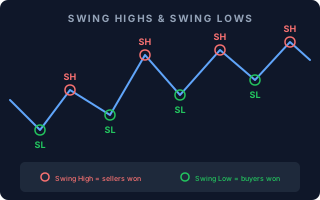
The foundation of market structure is identifying swing points — the peaks and valleys that price creates as it moves.
- Swing HighDefinitionA peak on the chart where price reversed lower. Marks where sellers previously overpowered buyers. — forms when price makes a local peak and then reverses lower. Buyers ran out of steam and sellers took control. The highest point between two lower candles on either side
- Swing LowDefinitionA trough on the chart where price reversed higher. Marks where buyers previously overpowered sellers. — forms when price makes a local trough and then reverses higher. Sellers ran out of steam and buyers took control. The lowest point between two higher candles on either side
Why swing points matter:
- They are the market's memory — not just chart features
- Every swing highDefinitionA peak on the chart where price reversed lower. Marks where sellers previously overpowered buyers. is a level where sellers previously won
- Every swing lowDefinitionA trough on the chart where price reversed higher. Marks where buyers previously overpowered sellers. is a level where buyers previously won
- These levels become the reference points that all structural analysis is built on
Not all swing points are created equal. A swing highDefinitionA peak on the chart where price reversed lower. Marks where sellers previously overpowered buyers. on a 5-minute chart carries less weight than one on the daily. When analyzing structure, always start with the higher timeframeDefinitionThe longest timeframe in a multi-timeframe stack — typically daily or 4-hour. Determines overall bias. to establish the primary trend, then drill down to your execution timeframe to find entries.
How to Read Structure in Practice
Reading structure is a skill that becomes automatic with practice. Here is the process:
- Identify the most recent swing points — mark the obvious peaks and valleys on your chart. Do not overthink it. If you have to squint, it is not a swing point
- Compare each swing to the one before it — is the new high higher or lower than the last high? Is the new low higher or lower than the last low?
- Determine the current state — if both highs and lows are rising, you are bullish. If both are falling, you are bearish. If there is no clear pattern, you are in a range
- Watch for changes — the moment a swing lowDefinitionA trough on the chart where price reversed higher. Marks where buyers previously overpowered sellers. breaks in a bullish trend, or a swing highDefinitionA peak on the chart where price reversed lower. Marks where sellers previously overpowered buyers. breaks in a bearish trend, the structure may be shifting. This is where CHoCHDefinitionChange of Character — the first warning a trend may be ending. Price breaks a swing point in the opposite direction. and BOSDefinitionBreak of Structure — confirms a trend change. Price breaks the next swing point after CHoCH. come in (covered in the next lessons)
Every swing highDefinitionA peak on the chart where price reversed lower. Marks where sellers previously overpowered buyers. is a question: will buyers be strong enough to break through this time? Every swing lowDefinitionA trough on the chart where price reversed higher. Marks where buyers previously overpowered sellers. is a question: will sellers push past this level? The answers to these questions define the trend.
Common Mistakes
- Forcing structure on choppy charts — if you cannot clearly see higher highs and higher lows (or lower highs and lower lows), the market is probably ranging. Accept it and adjust
- Ignoring timeframe context — a bearish structure on the 1-minute chart inside a bullish daily trend is just a pullback. Always know where you sit in the bigger picture
- Changing bias too quickly — one broken swing point is a warning, not a reversal. Wait for confirmation (BOSDefinitionBreak of Structure — confirms a trend change. Price breaks the next swing point after CHoCH.) before flipping your entire thesis
- Over-marking swing points — not every minor wiggle is a swing point. Focus on the obvious ones that the majority of traders would agree on