
What Is a Fair Value Gap?
A Fair Value GapDefinitionA three-candle pattern where the wick of Candle 1 doesn't overlap with the wick of Candle 3, leaving a gap where only Candle 2 traded. Price tends to revisit. (FVGDefinitionFair Value Gap — a three-candle pattern where the wick of Candle 1 doesn't overlap with the wick of Candle 3. Price tends to return to fill these gaps.) is a three-candle pattern that creates a price inefficiency. It occurs when the wick of Candle 1 does not overlap with the wick of Candle 3, leaving a gap where only one candle's body traded.
In simpler terms: price moved so fast that it skipped over a range without properly trading through it. That gap represents unfilled orders — and the market tends to return to fill them.
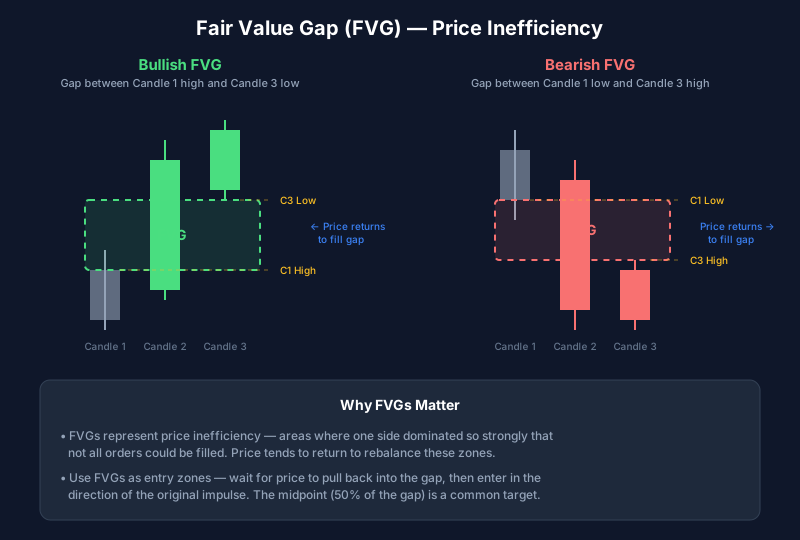
- Bullish FVGDefinitionFair Value Gap — a three-candle pattern where the wick of Candle 1 doesn't overlap with the wick of Candle 3. Price tends to return to fill these gaps. — the high of Candle 1 is below the low of Candle 3. The gap between them is bullish. Price moved up so aggressively that it left unfilled orders below. When price retraces to this gap, expect buying
- Bearish FVGDefinitionFair Value Gap — a three-candle pattern where the wick of Candle 1 doesn't overlap with the wick of Candle 3. Price tends to return to fill these gaps. — the low of Candle 1 is above the high of Candle 3. The gap between them is bearish. Price moved down so aggressively that it left unfilled orders above. When price retraces to this gap, expect selling
FVGsDefinitionFair Value Gap — a three-candle pattern where the wick of Candle 1 doesn't overlap with the wick of Candle 3. Price tends to return to fill these gaps. are one of the most reliable ICT concepts. Markets hate inefficiency. When a gap forms, price will usually return to at least the midpoint (50%) of the gap before continuing.
Why Do FVGs Get Filled?
Institutional traders need to fill orders at fair prices. When price moves too fast, not all orders get executed. The unfilled orders sit in the gap like a magnet, pulling price back.
Additionally, market makers have an obligation to provide liquidityDefinitionResting orders (stop losses, limit orders) at known levels. Institutions need liquidity to fill large positions. at all price levels. Gaps represent failure to do so. The rebalancing process — price returning to fill the gap — is how the market corrects this inefficiency.
The 50% Rule
The midpoint of an FVGDefinitionFair Value Gap — a three-candle pattern where the wick of Candle 1 doesn't overlap with the wick of Candle 3. Price tends to return to fill these gaps. (called consequent encroachment in ICT terminology) is a critical level. Many FVGs only get filled to the 50% mark before price continues in the original direction. This makes the midpoint a precision entry point:
- Measure the FVGDefinitionFair Value Gap — a three-candle pattern where the wick of Candle 1 doesn't overlap with the wick of Candle 3. Price tends to return to fill these gaps. from its high to its low
- The 50% level is your ideal entry
- Stop goes just beyond the full FVGDefinitionFair Value Gap — a three-candle pattern where the wick of Candle 1 doesn't overlap with the wick of Candle 3. Price tends to return to fill these gaps.
- Target is the next liquidityDefinitionResting orders (stop losses, limit orders) at known levels. Institutions need liquidity to fill large positions. level in the direction of the impulse
Inverse Fair Value Gaps
When an FVGDefinitionFair Value Gap — a three-candle pattern where the wick of Candle 1 doesn't overlap with the wick of Candle 3. Price tends to return to fill these gaps. that was previously filled gets revisited a second time, it becomes an inverse FVG. The polarity flips — a bullish FVG that acted as support now acts as resistance. Watch for these on retracements as they often mark the turning point.
FVGs on Different Timeframes
Higher timeframeDefinitionThe longest timeframe in a multi-timeframe stack — typically daily or 4-hour. Determines overall bias. FVGsDefinitionFair Value Gap — a three-candle pattern where the wick of Candle 1 doesn't overlap with the wick of Candle 3. Price tends to return to fill these gaps. (1H, 4H, Daily) carry more weight than lower timeframeDefinitionThe shortest timeframe in a multi-timeframe stack — typically 1m or range bars. Used for trade triggers. FVGs (1m, 5m). When a lower timeframe entry aligns with a higher timeframe FVG, the probability of the trade increases significantly.
The best approach: use a higher timeframeDefinitionThe longest timeframe in a multi-timeframe stack — typically daily or 4-hour. Determines overall bias. to identify the FVGDefinitionFair Value Gap — a three-candle pattern where the wick of Candle 1 doesn't overlap with the wick of Candle 3. Price tends to return to fill these gaps. zone, then drop to a lower timeframeDefinitionThe shortest timeframe in a multi-timeframe stack — typically 1m or range bars. Used for trade triggers. (footprint chartDefinitionA chart showing bid and ask volume at every price inside each candle. Reveals who is buying and selling.) to find your precise entry within that zone using order flow confirmation.
Our Market Structure Indicator for NinjaTrader automatically detects and plots FVGsDefinitionFair Value Gap — a three-candle pattern where the wick of Candle 1 doesn't overlap with the wick of Candle 3. Price tends to return to fill these gaps. on your chart in real-time — no manual drawing required. It highlights both bullish and bearish gaps so you can focus on trading the setups.