
Swing Movements: How Price Actually Moves
Price does not move in a straight line. It moves in swings — a series of impulse legsDefinitionA sharp, fast move that establishes the trend direction. The big candles. Don't chase these — wait for the pullback. and correction legsDefinitionThe pullback after an impulse move. Slower and choppier. This is where the entry opportunity is. that together create the trend. Understanding this rhythm is the foundation for everything that follows.
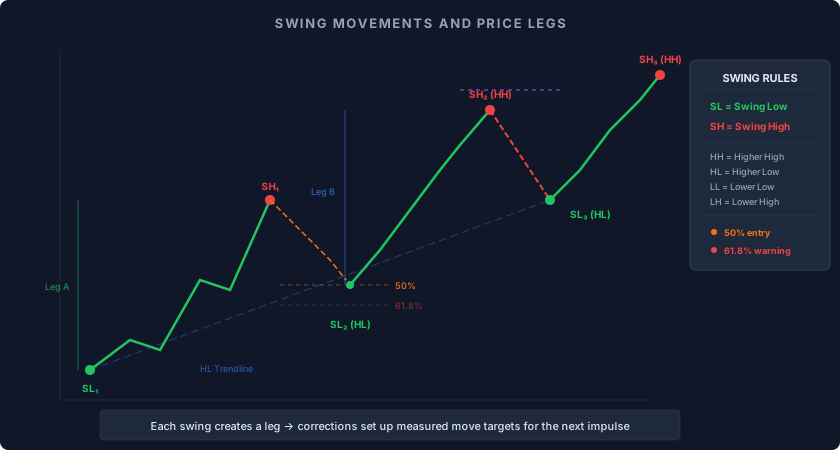
Every swing movement has two components:
- Impulse legDefinitionA sharp, fast move that establishes the trend direction. The big candles. Don't chase these — wait for the pullback. — the sharp, directional move with conviction. High deltaDefinitionAsk volume minus bid volume. Positive = more buying. Negative = more selling. Shows who is more aggressive., stacked imbalancesDefinition3+ consecutive price levels where one side overwhelms the other by 3:1. Marks institutional zones., and strong momentum. This is the "move"
- Correction legDefinitionThe pullback after an impulse move. Slower and choppier. This is where the entry opportunity is. — the pullback that follows. Lower volume, choppy price action, and mean-reversion back toward fair value. This is the "pause"
Reading Swing Structure
The sequence of swing highsDefinitionA peak on the chart where price reversed lower. Marks where sellers previously overpowered buyers. and swing lowsDefinitionA trough on the chart where price reversed higher. Marks where buyers previously overpowered sellers. tells you the trend:
- Higher highs + higher lows = bullish structure. Every correction is a buying opportunity
- Lower highs + lower lows = bearish structure. Every rally is a selling opportunity
- Equal highs + equal lows = range/balance. Trade mean reversion until a break occurs
Swing Legs Are Not Equal
Not all legs are the same size. But they tend to rhyme. This is the foundation of measured movesDefinitionA price projection where Leg B equals Leg A. Halsey's primary target is the -23.6% extension beyond 100%. — the observation that Leg B often equals Leg A in distance.
Key measurements to track on every swing:
- The size of the impulse legDefinitionA sharp, fast move that establishes the trend direction. The big candles. Don't chase these — wait for the pullback. in points
- The depth of the correction as a percentage of the impulse (common retrace zones: 50%, 61.8%, 78.6%)
- The time duration of each leg — impulses are fast, corrections are slow
- Whether the correction holds above the prior swing lowDefinitionA trough on the chart where price reversed higher. Marks where buyers previously overpowered sellers. (bullish) or breaks it (structure change)
David Halsey's Approach to Swings
David Halsey literally wrote the book on this — Trading the Measured Move. If you want to go deeper, it is a must-read. His approach boils down to:
- Identifying the current swing legDefinitionA single directional price movement between swing points. Measured in points to project future targets. — are you in an impulse or a correction?
- Measuring the prior impulse to project where the next one will go
- Using the 50% retracement as the primary entry zone (not 61.8%)
- Treating every new swing as a fresh setup, not a continuation of the old one
If you are new to impulse and correctionDefinitionEvery trend is a series of impulse legs (the move) and correction legs (the entry). See the market structure lesson. legs, start with the market structure lesson on impulse and correction before continuing here.
Every swing legDefinitionA single directional price movement between swing points. Measured in points to project future targets. is a trade. The impulse tells you the direction. The correction gives you the entry. The measured moveDefinitionA price projection where Leg B equals Leg A. Halsey's primary target is the -23.6% extension beyond 100%. gives you the target. This cycle repeats until the market tells you it has changed.