
Premium and Discount: Where Are You Buying?
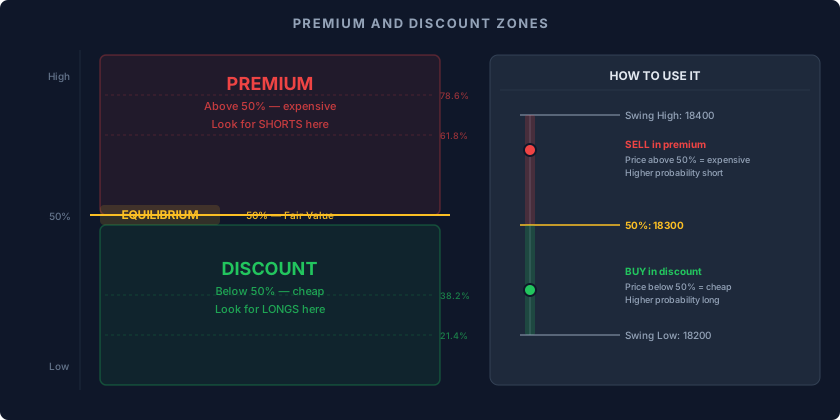
Every swing range has a top half (premium) and a bottom half (discount). The 50% level — the equilibriumDefinitionThe 50% level of a swing range — fair value. Above = premium. Below = discount. — divides them. This simple concept changes how you think about every entry.
The Core Principle
- Discount zoneDefinitionLower half of a swing range (below 50%). Price is cheap — look for longs here, not shorts. (below 50%) — price is cheap relative to the current range. This is where you look for longs. You are buying at a discount to fair value
- Premium zoneDefinitionUpper half of a swing range (above 50%). Price is expensive — look for shorts here, not longs. (above 50%) — price is expensive relative to the current range. This is where you look for shorts. You are selling at a premium to fair value
- EquilibriumDefinitionThe 50% level of a swing range — fair value. Above = premium. Below = discount. (50%) — fair value. Neither cheap nor expensive. The market agrees on this price
How to Apply It
Calculate the premium/discount zoneDefinitionLower half of a swing range (below 50%). Price is cheap — look for longs here, not shorts. for any swing:
- Find the most recent swing highDefinitionA peak on the chart where price reversed lower. Marks where sellers previously overpowered buyers. and swing lowDefinitionA trough on the chart where price reversed higher. Marks where buyers previously overpowered sellers.
- Calculate the 50% level: (High + Low) / 2
- Above 50% = premium. Below 50% = discount
- Layer in Fibonacci levels: 61.8%, 70.5%, 78.6% in discount are the best long entries. The same levels in premium are the best short entries
Example:
- Swing HighDefinitionA peak on the chart where price reversed lower. Marks where sellers previously overpowered buyers.: 18400, Swing LowDefinitionA trough on the chart where price reversed higher. Marks where buyers previously overpowered sellers.: 18200
- 50% equilibriumDefinitionThe 50% level of a swing range — fair value. Above = premium. Below = discount.: 18300
- Discount zoneDefinitionLower half of a swing range (below 50%). Price is cheap — look for longs here, not shorts.: 18200-18300 (buy here)
- Premium zoneDefinitionUpper half of a swing range (above 50%). Price is expensive — look for shorts here, not longs.: 18300-18400 (sell here)
- 61.8% discount: 18276 (optimal long entry)
Premium/Discount on Multiple Timeframes
The concept scales across timeframes:
- Daily range — is price in the premium or discount of today's range?
- Weekly range — is the current day trading in the upper or lower half of the week?
- Monthly range — where are we relative to the monthly high and low?
The highest probability trades occur when multiple timeframes agree. If the daily, weekly, and monthly ranges all show price in discount — that is a high-probability long zone. If they all show premium — that is a high-probability short zone.
Using Premium/Discount With Measured Moves
The two concepts work together:
- A measured moveDefinitionA price projection where Leg B equals Leg A. Halsey's primary target is the -23.6% extension beyond 100%. target in the premium zoneDefinitionUpper half of a swing range (above 50%). Price is expensive — look for shorts here, not longs. of a higher timeframeDefinitionThe longest timeframe in a multi-timeframe stack — typically daily or 4-hour. Determines overall bias. range is likely to act as resistance — take profits there
- A correction into the discount zoneDefinitionLower half of a swing range (below 50%). Price is cheap — look for longs here, not shorts. of the current swing is the measured moveDefinitionA price projection where Leg B equals Leg A. Halsey's primary target is the -23.6% extension beyond 100%. entry — buy there
- If the measured moveDefinitionA price projection where Leg B equals Leg A. Halsey's primary target is the -23.6% extension beyond 100%. target lands at or near the equilibriumDefinitionThe 50% level of a swing range — fair value. Above = premium. Below = discount. of a higher timeframeDefinitionThe longest timeframe in a multi-timeframe stack — typically daily or 4-hour. Determines overall bias. range, expect a reaction but not necessarily a reversal
Never buy in premium. Never sell in discount. This one rule will eliminate half of your losing trades. If you catch yourself buying above the 50% level of the current range — askDefinitionThe lowest price someone is currently willing to sell at. If you buy at market, this is what you pay. yourself why you are paying more than fair value.