
Impulse and Correction: The Rhythm of the Market
Markets do not move in straight lines. They move in impulse legsDefinitionA sharp, fast move that establishes the trend direction. The big candles. Don't chase these — wait for the pullback. and correction legsDefinitionThe pullback after an impulse move. Slower and choppier. This is where the entry opportunity is..
- Impulse LegDefinitionA sharp, fast move that establishes the trend direction. The big candles. Don't chase these — wait for the pullback. — the sharp, directional move that establishes or continues the trend. Big candles, fast moves, momentum. Impulse legs break structure and create new swing points
- Correction LegDefinitionThe pullback after an impulse move. Slower and choppier. This is where the entry opportunity is. — the pullback or retracement that follows the impulse. Slower, choppier, moves against the trend. Retraces a portion of the impulse before the next leg fires
The trading implication:
- The impulse legDefinitionA sharp, fast move that establishes the trend direction. The big candles. Don't chase these — wait for the pullback. is the signal — it tells you the direction
- The correction legDefinitionThe pullback after an impulse move. Slower and choppier. This is where the entry opportunity is. is the opportunity — it gives you the entry
- Professional traders never chase the impulse
- Wait for the correction and enter at a key level where the next impulse is likely to begin
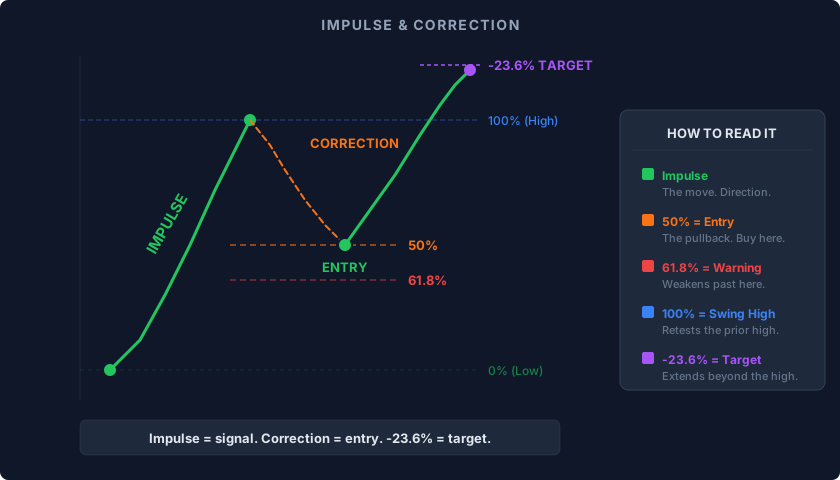
Impulse tells you what to trade. Correction tells you where to enter. Never chase the impulse — the retest during the correction is where the real trade is.
To learn how to measure impulse legsDefinitionA sharp, fast move that establishes the trend direction. The big candles. Don't chase these — wait for the pullback. and project where the next one will go, see the measured moves lessonDefinitionLearn how to project price targets using Leg A = Leg B, plus Halsey's -23.6% extension target. in the Price Action course.
Multi-Timeframe Structure
One of the most powerful applications of market structure is using it across multiple timeframes. The higher timeframeDefinitionThe longest timeframe in a multi-timeframe stack — typically daily or 4-hour. Determines overall bias. structure always takes priority.
- Higher TimeframeDefinitionThe longest timeframe in a multi-timeframe stack — typically daily or 4-hour. Determines overall bias. (1H / 4H) — the thesis. Tells you the overall direction. If the higher timeframe is bullish, your bias is long regardless of what the 5-minute chart looks like
- Mid Timeframe (15M) — the level. Identifies the key levels where you want to trade: BOSDefinitionBreak of Structure — confirms a trend change. Price breaks the next swing point after CHoCH. levels, swing points, measured moveDefinitionA price projection where Leg B equals Leg A. Halsey's primary target is the -23.6% extension beyond 100%. targets
- Lower TimeframeDefinitionThe shortest timeframe in a multi-timeframe stack — typically 1m or range bars. Used for trade triggers. (1M / 5M) — the trigger. Gives you the precise entry. Watch for CHoCHDefinitionChange of Character — the first warning a trend may be ending. Price breaks a swing point in the opposite direction. and BOSDefinitionBreak of Structure — confirms a trend change. Price breaks the next swing point after CHoCH. on the lower timeframe to confirm the higher timeframeDefinitionThe longest timeframe in a multi-timeframe stack — typically daily or 4-hour. Determines overall bias. thesis
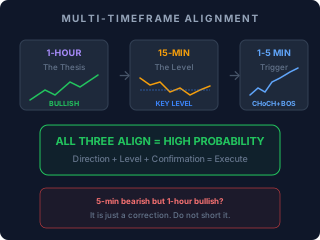
When all three timeframes agree — higher timeframeDefinitionThe longest timeframe in a multi-timeframe stack — typically daily or 4-hour. Determines overall bias. direction, mid timeframe level, lower timeframeDefinitionThe shortest timeframe in a multi-timeframe stack — typically 1m or range bars. Used for trade triggers. trigger — you have the highest probability setup in futures trading.
Common mistake to avoid:
- Do not let the lower timeframeDefinitionThe shortest timeframe in a multi-timeframe stack — typically 1m or range bars. Used for trade triggers. override the higher timeframeDefinitionThe longest timeframe in a multi-timeframe stack — typically daily or 4-hour. Determines overall bias.
- If the 5-minute is bearish but the 1-hour is bullish, the 5-minute selloff is likely just a correction legDefinitionThe pullback after an impulse move. Slower and choppier. This is where the entry opportunity is. in the larger uptrend
- Do not short a pullback against a bullish higher timeframeDefinitionThe longest timeframe in a multi-timeframe stack — typically daily or 4-hour. Determines overall bias.